









The Coming Wave of Competition in LEO Constellations
After years of Starlink holding a commanding lead in LEO broadband, analysts and industry experts see a shift in the constellation race. Aggressive launch schedules for new services, differentiated offerings, and geopolitics are all driving greater competition in an expanding market.February 23rd, 2026
The Low-Earth Orbit (LEO) race is heating up after years of Starlink setting the pace for satellite broadband. Amazon plans to deploy 700 Amazon Leo satellites by mid-2026. Eutelsat’s OneWeb revenues were up 60 percent for the first half of the year. Telesat has $1 billion-dollar backlog two years before deploying Telesat Lightspeed, and new entrants like Blue Origin’s TeraWave are making a play for terrestrial-grade connectivity from space.
“I would say it is a legitimate race,” said Caleb Henry, director of research at Quilty Space. “I actually think this is the year we will see that for the first time.”
With Amazon Leo services expected to hit the market this year, “a lot of folks that are buying satellite capacity and terminals really anticipate getting to play the two off of each other — or at least have the option to choose between more than one competitive LEO offering,” Henry said.
Amazon vs. SpaceX
By the end of February, Amazon had launched a total of 212 satellites. It expects to increase CapEx on Amazon Leo by $1 billion this year with 20 more launches in 2026, and more than 30 next year. After testing services with select enterprise customers and rebranding from Kuiper to Amazon Leo, Amazon debuted its Leo Ultra offering, touting 400 Mbps upload and 1 Gbps download speeds and private, direct access to AWS. It is also planning to offer more accessible plans for home and small businesses.
“This is really the year it all comes together,” said Chris Weber, vice president of Consumer and Enterprise for Amazon Leo. “We've got hundreds of satellites already built, we're ramping up our launch cadence significantly in 2026, and we're making massive investments in launch services and ground infrastructure. The momentum is very real.”
The excitement comes with an undercurrent of urgency. In February, Amazon filed a request with the Federal Communications Commission (FCC) for a two-year extension of a pending July milestone to have half of its 3,232-satellite constellation deployed. According to the filing, the company expects to have 700 satellites in orbit by July, which would surpass Eutelsat’s OneWeb constellation to become the second-largest deployed LEO constellation, though still shy of the FCC target.
“We feel good about where we are,” Weber said of the timeline. “Our progress is not theoretical, it's tangible.”

Room to Grow
“There used to be a frequently asked question on panels of how many constellations can the market support? I think the consensus was usually around two or three,” said Henry. “In a world where constellations weren’t also a political asset, that’s probably what it would end up being. But because of their importance, we’re likely to see twice as many.”
The early 2020s saw jaw-dropping filings with the International Telecommunications Union (ITU) for hundreds of thousands of Non-Geostationary Satellite Orbit (NGSO) communications satellites. Much of the hype around those “paper satellites” has settled, and the discussion is shifting from too little demand to too little supply.
According to Carlos Placido, independent consultant and satcom advisor, current infrastructure is only scratching the surface of demand. Analysis using the Non-GEO Constellations Analysis Tool (NCAT) has shown consistently that “mega-constellations struggle to reach even 10 percent of the addressable consumer and enterprise market,” he told Via Satellite. “The market will require significantly more capacity, meaning the overall supply pie has room to grow.”
Amazon Leo reports significant advance demand from consumers, governments and enterprises. “The reality is, the demand signals we're seeing are incredibly strong across every segment,” said Weber. Citing the global digital divide, he added, it “will take more than one or two constellations” to reach the hundreds of millions of people who lack meaningful connectivity.
In Europe, Eutelsat revenues from OneWeb services were up 60 percent in its half-year results, with projections of up to 280 million euro ($300 million) by the end of the current fiscal year.
“We are competing in a market which is growing very strongly,” said Joanna Darlington, Eutelsat chief communications officer, citing forecasts that B2B demand for LEO capacity could increase five-fold by the end of the decade.
At the same time, new services are displacing Eutelsat’s legacy Geostationary Orbit (GEO) business. “LEO is the only part of the connectivity market that is really growing,” Darlington continued. “What we see in day-to-day operations is that LEO is massively outpacing demand for GEO. And in many cases, it’s starting to cannibalize it as well.”
Eutelsat is projecting revenues upwards of 1.5 billion euro ($1.8 billion) by the end of fiscal year 2028-2029, with LEO services not only driving growth but largely offsetting declines in other services. The company is investing heavily in OneWeb, including roughly 2 billion euro ($2.3 billion) to replenish 440 of its first-generation satellites before deploying next-generation capabilities for IRIS² by 2030.
According to Stephen Hampton, Telesat’s senior director of government affairs and strategic accounts, Ottawa-based Telesat Lightspeed is gearing up to fill a backlog of over $1 billion in orders nearly two years before the start of service.
“We’ll be coming to market at the right time to meet the moment,” Hampton told Via Satellite. Telesat has announced enterprise service agreements with ADN Telecom, Orange, Viasat and Vocus, as well as a memorandum of understanding with Korea’s Hanwha Systems, and a strategic partnership with Canada for government and defense services.
Following delays in production and financing, Telesat says it is moving quickly to deploy services by the end of 2027. At the start of 2026, manufacturer MDA Space had completed its 180,0000 square foot manufacturing facility to build the satellites and Telesat had contracted 14 launches on SpaceX Falcon 9, with each launch carrying roughly 15 of the company’s 800-kilogram class satellites.
What a Difference Differentiation Makes
SpaceX has been “an exceptionally difficult competitor to challenge,” said Placido. Starlink began 2026 with roughly 9,500 working satellites in orbit and FCC approval for an additional 7,500. Its customer base had nearly doubled over the previous year to 9.2 million users in about 155 countries. With no other NGSO operator actively offering consumer broadband service, Starlink has maintained a de facto monopoly in that sector, while extending its penetration into enterprise, maritime, aviation, government, and direct-to-device.
Historically, cost has been one of the biggest challenges of head-to-head competition with Starlink, with the company offering $0.30 to $0.50 Mpbs plans — and projections of further price erosion with Amazon Leo.
“However, competition in LEO broadband should no longer be assessed solely through the lens of transport cost per bit,” Placido advised. “Ultimately, sustainable competition in LEO broadband will be driven by differentiated ecosystems with a sharp focus on key verticals, rather than by attempts to undercut Starlink on cost alone.”
Only Amazon is currently positioned to challenge SpaceX in the consumer market. Blue Origin, Telesat, OneWeb, and new players like Logos Space and Open Cosmos are all carving their niche in enterprise, government, and defense, where they are differentiating on technical specs, security, reliability, and interoperability more than raw bandwidth.
Rather than developing stovepiped systems, most competing constellations are tapping into the global standards environment. OneWeb and Telesat Lightspeed are both designed to integrate into the terrestrial telecommunications ecosystem through 3GPP’s 5G standards. OneWeb’s first-generation replacement satellites will include hardware updates for enhanced 5G backhaul. Telesat has also adopted Metro Ethernet Forum standards for Carrier Ethernet. French startup Univity, (formerly Constellation Technologies and Operations), could emerge as the first 5G native constellation after recently testing the first regenerative 5G payload in Very Low Earth Orbit (VLEO).
When Blue Origin announced TeraWave at the beginning of the year, set out on a differentiated path based on anticipated technical performance, with 5,408 optically interconnected satellites in LEO and Medium Earth Orbit (MEO) using Q/V-band links to deliver symmetrical upload and download speeds of up to 144 Gbps. The privately-held company is targeting a niche market of just 100,000 users, such as data centers, telcos, cloud provides and governments, who need low-latency, ultra-high-throughput, comparable to terrestrial fiber and Ethernet.
“TeraWave was created to address an unmet need among customers seeking enterprise-grade internet access,” a Blue Origin representative said in a statement to Via Satellite. “Because of this, TeraWave was not designed to compete with others in this space but to fill this gap.”
The Role of Sovereignty
The competitive edge that cannot be ignored is government demand for sovereign, secure connectivity. Constellations like the European Union’s IRIS² or China’s Thousand Sails (Qianfan) and GuoWang are increasingly viewed as strategic assets to mitigate the potential risks of a single nation or operator dominating Low-Earth Orbit.
“By being a European player, we do have an advantage for certain sovereign applications,” said Darlington. “There are lots of customers on the government side that do not necessarily want to use a U.S. supplier.”
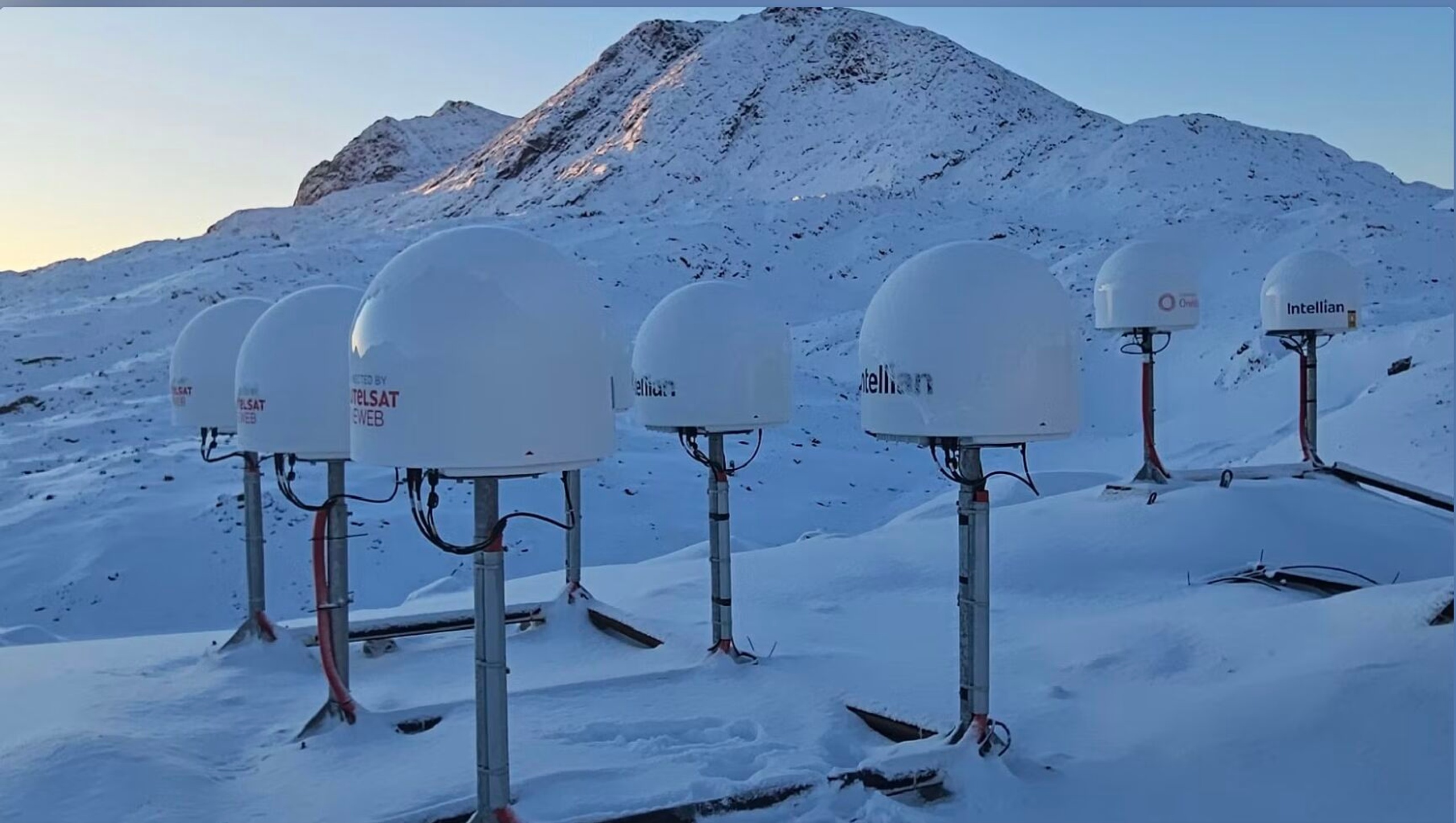
OneWeb’s parent company Eutelsat, has been described as a “strategic jewel” for Europe and recently secured 975 million euro ($1.15 billion) in government export credit financing after raising 1.5 billion euro ($1.8 billion) in late 2025 from the French government and other core stakeholders. In addition to its 10-year $1 billion framework agreement with the French Ministry of Defense, it is also selling OneWeb capacity over Taiwan and recently entered a multi-year agreement with Greenland’s national telco Tusass for critical infrastructure, community broadband, maritime, mobility and emergency services.
Eutelsat is also a founding member of the SpaceRISE consortium, leading the development of IRIS², Europe’s dedicated, sovereign LEO-MEO broadband constellation. While some critics have voiced concerns over IRIS² requirements adding cost and time, Placido highlighted the potential long-term benefits of the approach.
“Europe’s IRIS² initiative, with emphasis on ecosystems and standards, may constrain deployment speed but could enhance long-term sustainability and strategic relevance,” he said.
Geopolitics are also impacting demand for Telesat Lightspeed, according to Hampton. “We’re seeing countries all over the world aggressively go out and look for LEO satcom partners.”
Nations want secure, sovereign connectivity, he noted, but few can afford sovereign constellations.
“We’re seeing this pretty rapid transition from government-owned, government-operated to commercially-owned, commercially-operated,” Hampton continued. “We identified early that data sovereignty is a key aspect of this and we built all of the capabilities into the network to ensure that we are enabling that data sovereignty.” Telesat’s approach includes direct terminal-to-terminal connectivity, an optical mesh, as well as jam-resistant features and a zero-trust architecture.
Open Cosmos, the British-headquartered company that was recently awarded Lichtenstein’s high-priority Ka-band spectrum filings previously held by Rivada Space Networks, is also aligned with the trend toward strategic autonomy.
“Being a sovereign system, in terms of our European market, is of great value,” said Open Cosmos Vice President Matthew Child. “But there’s also a national strategic position as well with the geopolitical landscape changing and LEO satcom capability now viewed as critical national infrastructure.”
As a vertically integrated company with manufacturing and testing facilities in the U.K, Spain, Portugal and Greece, Open Cosmos says it can control mission lifecycles and significant portions of its supply chain. “That’s good for security. For the target customers, government and national security, this has become quite important to them,” Child told Via Satellite.
Like other operators, Open Cosmos has an aggressive deployment timeline, with ITU milestones approaching in June and September. The company is optimistic after successfully activating its Ka-band filing on Jan. 22, when it launched a pair of satellites. It has additional launches scheduled throughout the year.
“We’ve got quite challenging milestones to meet,” said Child. “But we’re in control of our cost base. We’ve got our supply chains, our suppliers are all lined up. We’re very confident. And of course, Lichtenstein is very confident we will make it, or they would not have issued the rights to this frequency band.”
New Entrants Could Bring More Disruption
Starlink’s entry into the satellite connectivity market revealed a massive source of untapped demand. According to Novaspace, NGSO services are forecast to surge from 76 percent of global satcom and connectivity supply in 2022 to over 95 percent post-2026, driving overall service revenues well beyond $100 billion.
While Starlink demonstrated what was possible, the challenge for the next generation of LEO operators is making it affordable.
“Where I see the opportunity for these startups is if they can radically reduce the cost of obtaining a constellation,” said Henry. “I think that is the common thread of the new wave of startups: attempting to address how to bring constellations from something only the wealthiest companies and governments can obtain, to an asset that a normal satellite operator can also obtain.”
SpinLaunch is targeting October 2026 to launch the first customer link satellite in its Meridian constellation. The California-based company is pioneering a highly efficient reflector array antenna that reduces the weight of each satellite to 70 kg each, driving down the total contract price to $135 million for about 280 satellites.
Univity is planning to deploy its VLEO prototype in 2027 as an extension of terrestrial networks, using shared terrestrial 5G spectrum for broadband and narrowband services.
Logos Space is targeting high-end enterprise and government customers with “multigigabit connectivity” on a jam- and interference-resistant constellation of 4,178 satellites. The California-based startup recently secured FCC approval to operate in the Ka-, Q- and V-bands and plans to begin service in late 2027.
While the field is increasingly crowded and competitive, the market is also growing and maturing. Differentiated services are becoming a greater factor and more compelling for sectors with requirements that weren’t fully met with generic connectivity.
“It is absolutely a space race,” said Hampton. “It’s not going to be a winner-take-all market.” VS