









Satellite Technology of the Year Nominees for 2025
The six nominees for 2025 Satellite Technology of the Year award.February 23rd, 2026Since 2018, Via Satellite’s Satellite Technology of the Year award has recognized technologies that have saved lives, demonstrated scientific breakthroughs, and disrupted markets. Past winners include the Agatha AI space domain awareness capability, the integration of satellite into 3GPP standards, and Apple’s emergency messaging via satellite.
The winner of the award will be determined by a public vote combined with the votes of the Via Satellite editorial board. The winner will be announced during the Via Satellite awards luncheon on Wednesday, March 25, during SATShow Week in Washington, D.C. Voting is open online from Feb. 23 to 12 p.m. on March 24 and can be accessed at satellitetoday.com/vote. Here are the 2025 Technology of the Year nominees:

Blue Ghost Lunar Lander, Firefly Aerospace
In March 2025, Firefly Aerospace became the first private company to successfully land on the lunar surface. While carrying 10 instruments for NASA, Firefly’s Blue Ghost Mission 1 demonstrated commercial agility, technical endurance, and groundbreaking science in surpassing its mission requirements. In addition, it renewed hope in the future cislunar economy for the space industry and its investors.
On the technical side, Firefly’s Blue Ghost stands out for its "dual-use" capability as a robust heavy-duty transport and a sophisticated scientific laboratory. Its technical achievements on the Blue Ghost mission are significant, and include: successful robotic drilling that accessed deeper lunar strata than any prior mission; the first-ever tracking of GPS signals on the Moon; and capturing X-ray imagery of Earth’s magnetosphere and high-definition footage of a total solar eclipse from the lunar surface.
The lander’s architecture leveraged Firefly’s flight-proven technology, ensuring reliability through a vertically integrated "in-house" build. Blue Ghost also displayed impressive durability. In addition to more than 500 hours of mission simulations, the platform survived a staggering 500 degrees Fahrenheit temperature delta, swinging from the blistering heat of lunar noon to the cryogenic depths of a solar eclipse. The team operating Blue Ghost deserve credit for operational creativity. During the mission’s "Operation Parasol" phase, the Firefly team repurposed the lander’s high-gain antenna as a makeshift sunshade, gimbaling the hardware to protect the top deck from thermal overload. This ingenuity allowed the mission to transmit 120 gigabytes of data — significantly exceeding the primary mission's success criteria and providing the industry with vital data on how lunar dust interacts with thermal radiators.
Firefly Aerospace’s achievements with Blue Ghost will have long-term impact in lowering the barrier to entry for lunar exploration. By executing the longest commercial lunar operation to date, Blue Ghost demonstrated that private enterprises can lead complex, multi-week missions once reserved for the world’s most established civil space agencies.
Direct-to-Device Satellite Connectivity, Skylo
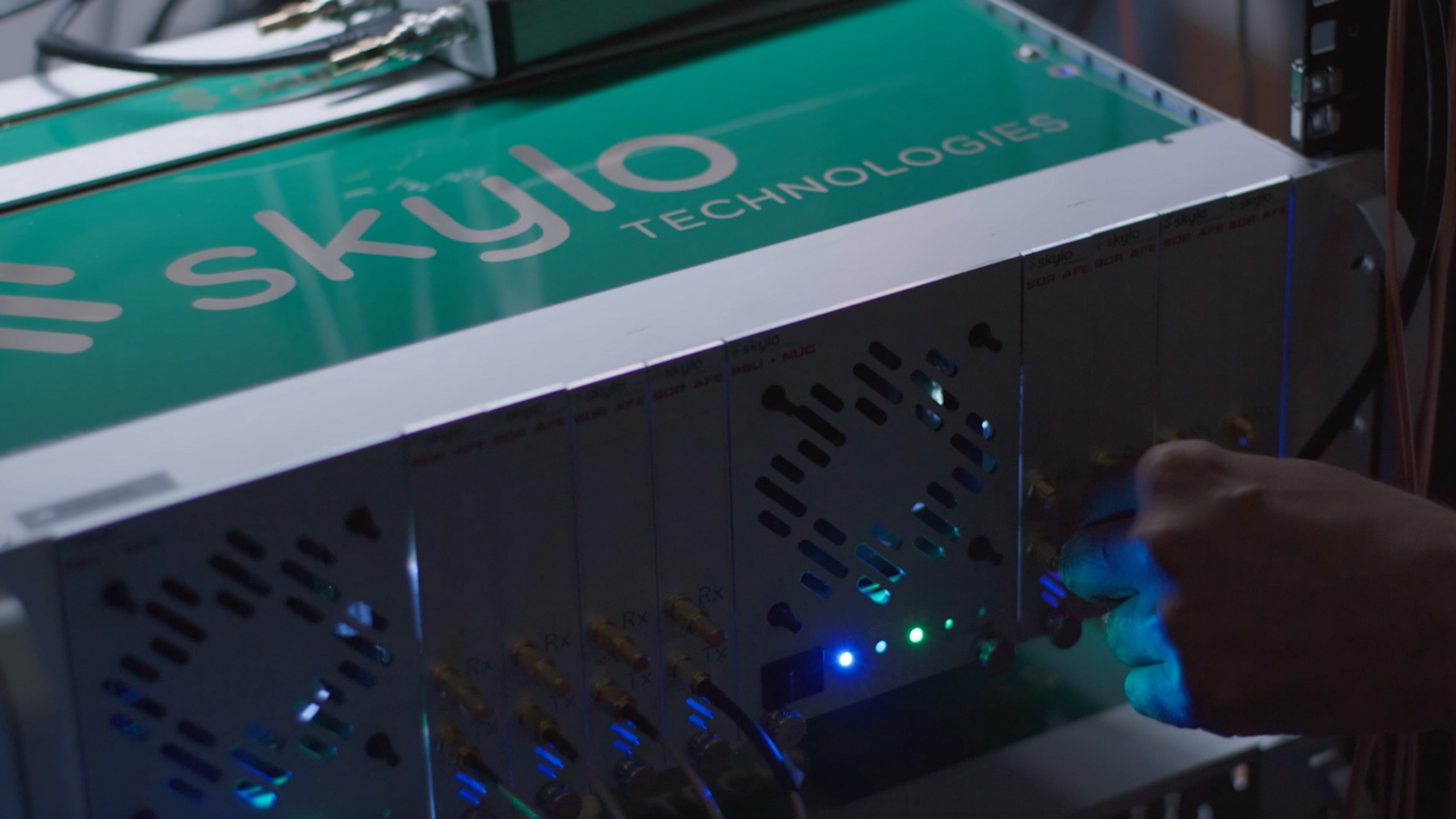
Skylo’s direct-to-device (D2D) connectivity represents a fundamental milestone in the industry’s quest to dissolve the barrier between terrestrial and satellite networks. By enabling standard smartphones, wearables, and vehicles to connect directly to satellites without specialized hardware or bulky antennas, Skylo has transformed satellite access from a niche, "last-resort" luxury into a mainstream, life-saving utility.
Unlike proprietary systems, Skylo leverages existing cellular chipsets, working with providers like Qualcomm, Samsung, and MediaTek, alongside software-defined non-terrestrial network (NTN) standards. This carrier-grade infrastructure allows for seamless bi-directional communication — including messaging, SOS alerts, and location sharing — integrated directly into ubiquitous devices like smartphones and wearables.
After launching the first Android bi-directional satellite messaging service in 2024, Skylo immediately went to work on scaling the service. In 2025, Skylo expanded the network to cover 70 million square kilometers across five continents. The company is cleverly tackling the challenge of eliminating coverage “dead zones” through its recent strategic partnerships with global operators like Verizon, Deutsche Telekom, and Orange. This will enable them to both establish the trust of consumers and also provide a resilient backbone for critical maritime, logistics, and agriculture industries and real-time SOS capabilities.
By proving that satellite networks can work hand-in-hand with terrestrial services at scale, Skylo has contributed a significant shift toward a future of ubiquitous connectivity.
DiskSat, The Aerospace Corporation
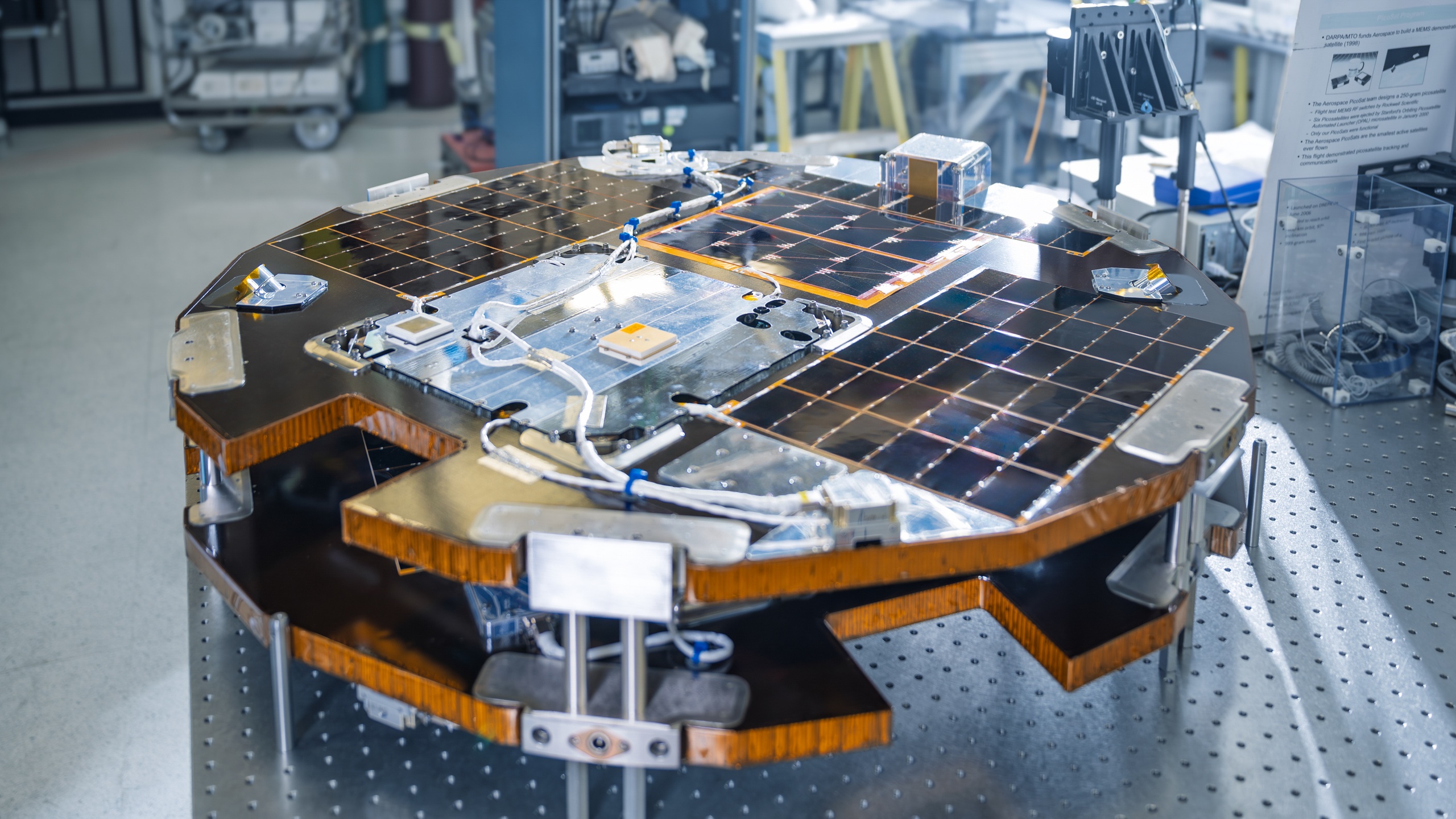
DiskSat earns a Technology of the Year nomination as a small satellite platform that reimagines spacecraft architecture, unlocks the potential of Very Low Earth Orbit (VLEO), and shatters the cubesat paradigm. DiskSat addresses two critical challenges for the industry at large: launch costs and orbital congestion. Its stackable design maximizes launch vehicle efficiency, lowering the barrier to entry for commercial and academic sectors.
Developed by the Aerospace Corporation, DiskSat moves the industry away from the traditional “box,” instead utilizing a flat, disk-shaped form factor — 1 meter in diameter and 2.5 centimeters thick. The platform combines the standardization of cubesats with the power and aperture of much larger satellites, creating a scalable solution for high-performance missions.
DiskSat’s carbon-fiber composite structure aims to offer an exceptional power-to-mass ratio, providing 13 times more solar surface area than traditional small satellites. Designed specifically for VLEO, it integrates electric propulsion to counter atmospheric drag, enabling sustained operations as low as 300 kilometers. This allows for sharper imaging and lower-latency communications while ensuring rapid, natural deorbiting to mitigate space debris.
During the past year, Aerospace transitioned DiskSat from concept to a flight-ready reality. In December, it launched four DiskSats on Rocket Lab’s STP-S30 mission. The deployment proves its worth as a novel multi-slot dispenser, allowing for safe, contact-free, stackable deployment of multiple spacecraft.
Aerospace is taking significant steps to advance the commercialization of DiskSat and broaden its impact. In addition to releasing technical interface documentation on DiskSat, the company is also initiating licensing discussions to transition this government-developed prototype into a commercially available platform for Earth Observation and space domain awareness.
FireSat, Muon Space
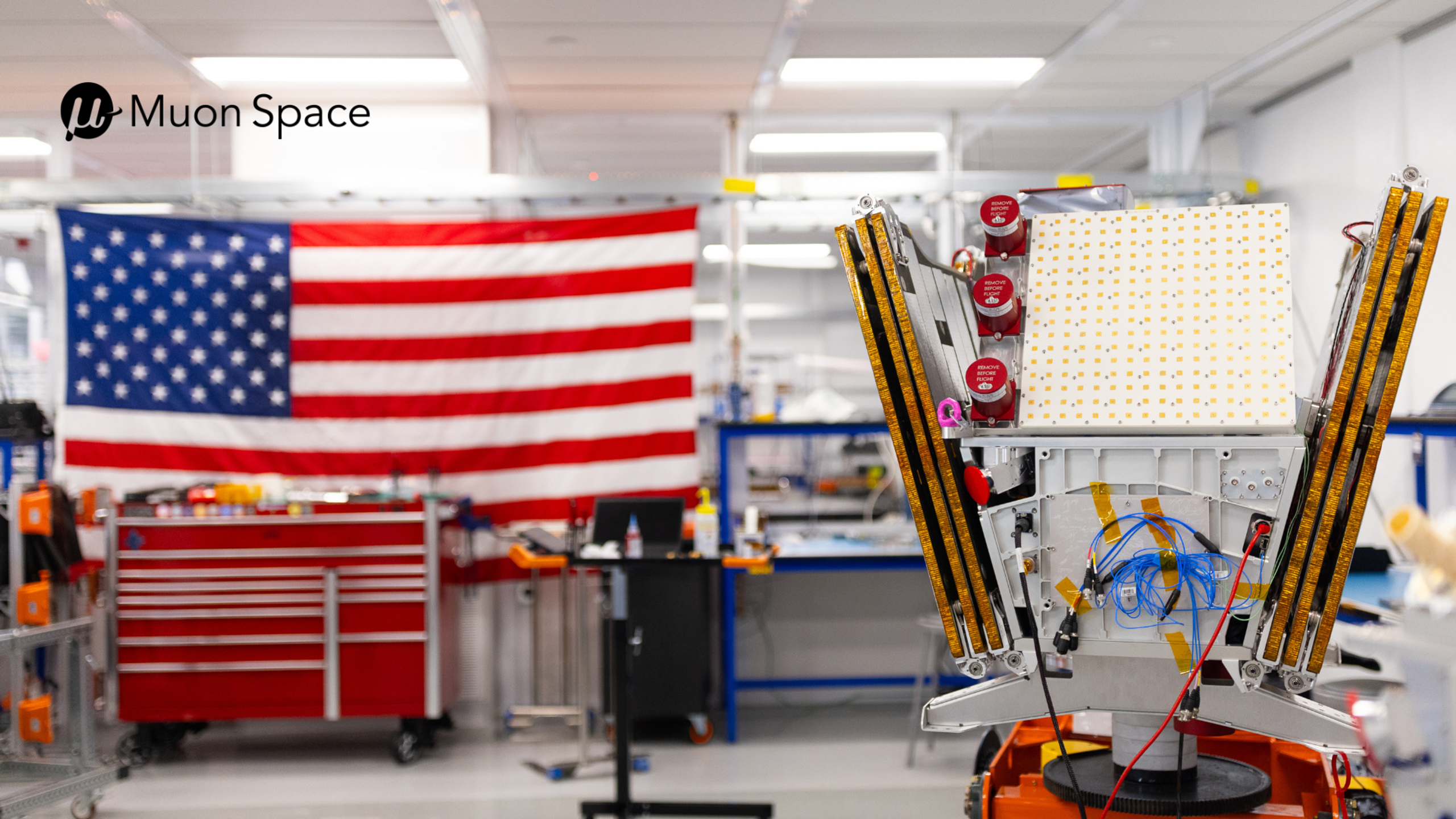
Named one of Time Magazine’s “Best Inventions of 2025,” Muon Space’s wildfire detection platform FireSat proves that small satellites operating in Low-Earth Orbit (LEO) can deliver high-performance environmental intelligence faster and more affordably than traditional programs.
FireSat is the industry’s first purpose-built satellite solution for early-stage fire monitoring. It is based on Muon Space’s vertically integrated Halo platform, utilizing a six-channel, high-dynamic-range multispectral infrared instrument to detect ignitions as small as 5 by 5 meters. The design aims to close critical capability gaps, offering high-resolution, actionable intelligence that large-scale national systems have historically failed to provide.
Muon Space developed FireSat’s unique sensor architecture in collaboration with the Earth Fire Alliance. The sensors allow the platform to see through smoke and clouds to measure fire perimeter, progression, and intensity without sensor saturation. From LEO, FireSat covers a 1,500 kilometer swath and provides a 50-meter ground sample distance.
Muon Space launched FireSat’s initial Protoflight in March 2025. Just four months later In July, the satellite detected a small wildfire in Oregon that existing orbital systems missed, proving its superior thermal sensitivity. Once the full constellation is deployed, FireSat will revisit high-risk regions every 20 minutes, ensuring that fires are identified at their earliest and most manageable stages. The implications of this are profound. In the U.S. alone, a one-hour revisit rate is projected to prevent over $1 billion in annual damage and reduce carbon emissions by 21.9 million tons. Because of this, FireSat more than proves its worth as a global infrastructure upgrade that protects communities, ecosystems, and the planet.
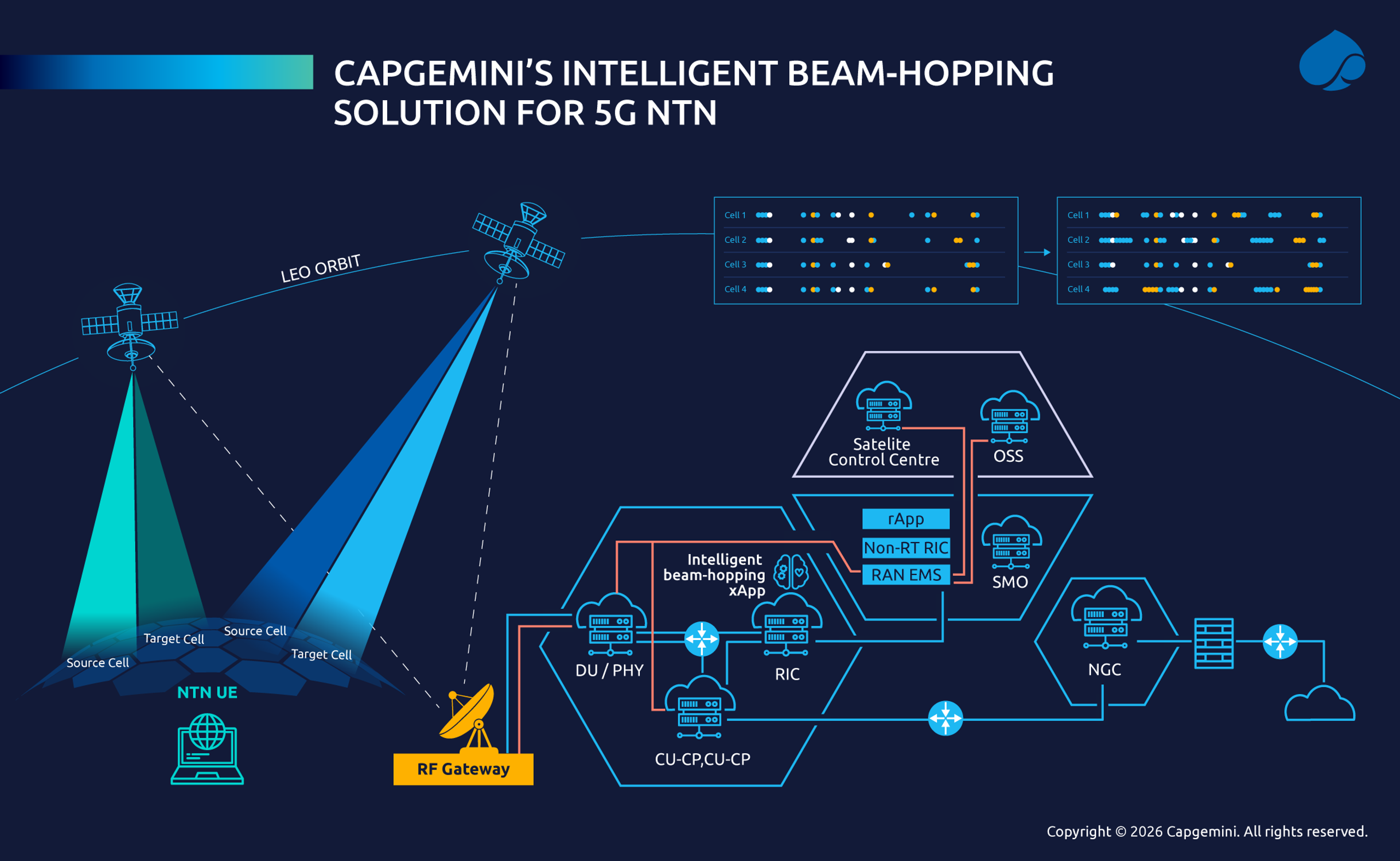
Intelligent Beam-Hopping Solution for 5G NTN, Capgemini
Beam-hopping in NTN is notoriously difficult due to propagation delays and the need for synchronized resource allocation. This is a major challenge for satellite operator business models built on connecting remote regions. In an effort to establish itself as a leader in NTN software at a crucial time when the satellite industry is pivoting towards 3GPP Release 17/18 standards, Capgemini has automated the beam-hopping process through its Intelligent Beam-Hopping Solution. The solution allows satellite control center time-plans to work with radio access network (RAN) configuration parameters to allow seamless, conflict-free air-interface signaling for next generation global connectivity services.
Capgemini designed the solution to address the critical complexity of maximizing cell capacity while minimizing satellite payload power constraints. The Intelligent Beam-Hopping Solution does this through automation in four key areas: “Time-Plan Definition,” which creates slot-level illumination based on real-time RAN configurations; “Conflict Resolution,” which includes detecting and resolving resource collisions across multiplexed cells; “Intelligent Optimization,” which synthesizes plans that meet capacity KPIs while accounting for dynamic traffic and link conditions; and “O-RAN Alignment,” which utilizes a Real-time Intelligent Controller (RIC) to manage both transparent and regenerative satellite architectures.
The Intelligent Beam-Hopping Solution enjoyed a successful debut at MWC Barcelona 2025 and has performed well throughout the year in the satellite operator market. Capgemini reported that customers utilizing Capgemini’s framework in 2025 reaped R&D cost savings of 20 to 25 percent compared to alternative options. This kind of result helps accelerate the realization of ubiquitous 5G, and gives operators the confidence to push services to field trials faster and more efficiently.
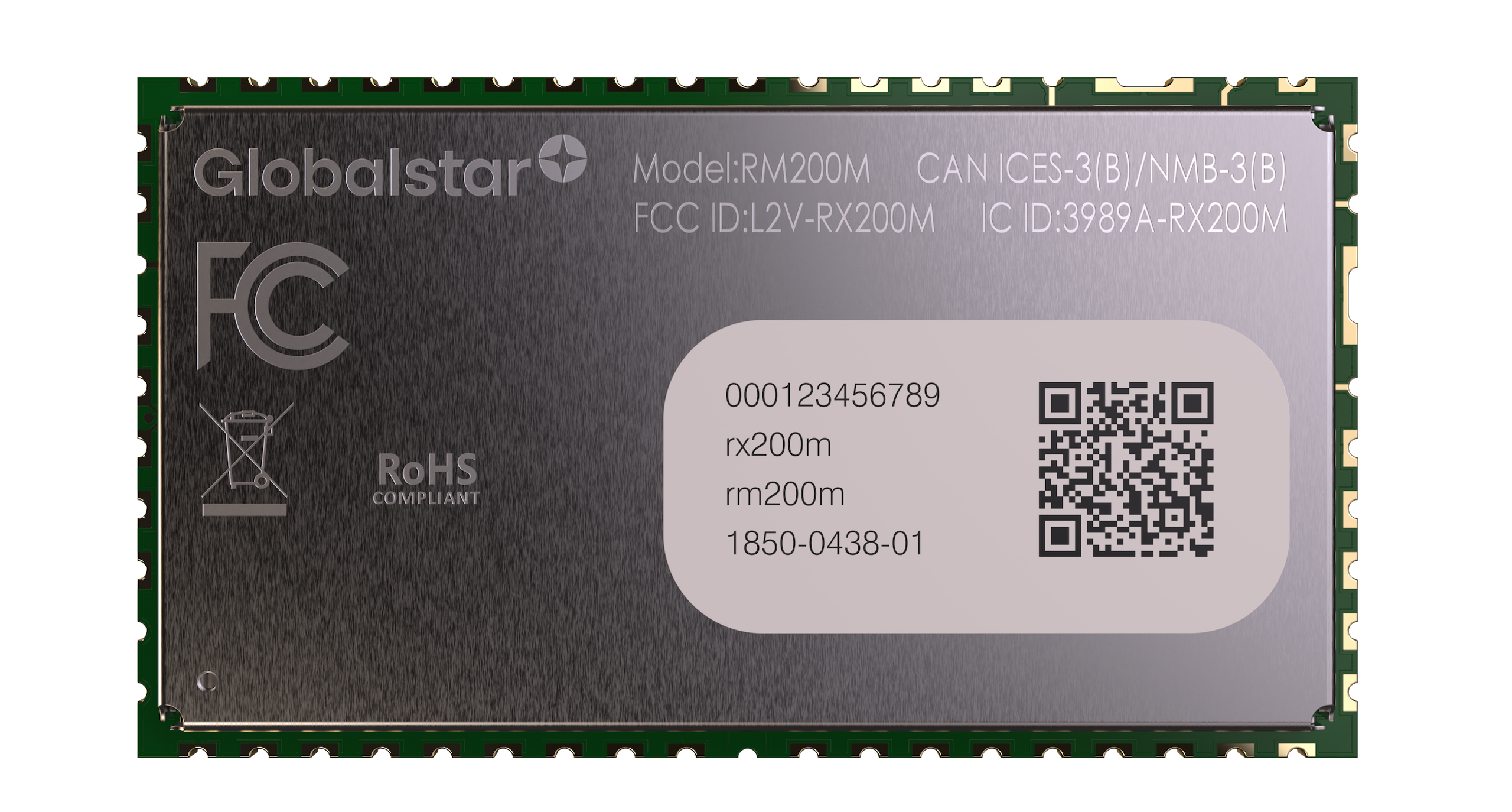
RM200M Module, Globalstar
Globalstar’s RM200M high-performance, two-way satellite module aims to set a new standard for industrial IoT and redefine how enterprises manage assets in the world’s most remote environments. Launched commercially in early 2025 and supported by Globalstar’s LEO satellite network, the RM200M stands out as the industry’s first satellite IoT module to integrate a comprehensive technology stack into a single, compact form factor.
The RM200M provides real-time visibility into remote pipelines, vessels, and supply chains for industrial end-users. It aims to minimize maintenance costs and prevent environmental disasters through early detection.
As a low-power solution for global M2M (machine-to-machine), the RM200M bridges the gap between traditional telemetry and modern edge-computing by consolidating hardware at the edge. It combines GNSS, Bluetooth, an accelerometer, and an application processor in a rugged design, enabling full two-way command and data processing rather than simple one-way tracking. The "all-in-one" architecture allows for localized data handling to optimize bandwidth and power. RM200M is also a major step forward for hybrid connectivity as it supports both satellite and future cellular handoffs.
Since receiving global certification for industrial use just one year ago, Globalstar has received a positive reception for the RM200M from early adopters in the oil and gas and other industrial sectors. These customers once saw satellite IoT as a niche backup. The RM200M helps clarify the potential of global satellite connectivity as affordable and practical for mainstream industrial use. The module’s success contributed to what is expected to be a year of record service revenue growth for Globalstar and has shifted the benchmark for two-way satellite communication. VS