





Driving Virtualization to the Edge
ETL Systems’ DIGITAL 1000 bridges the gap between traditional RF and the virtualized ground segment, even at the network edge.February 23rd, 2026
In recent years, the satellite industry has engaged in frequent discussion of the benefits of ground segment virtualization. That future is now on the horizon, and ETL Systems is playing a central role with DIGITAL 1000. This next-generation, edge-based digitizer extends Digital IF capability beyond the gateway and out to the terminal.
The Virtualization Movement
Interest in ground segment digitization is progressing from the exploration stage to the question of execution. The industry is looking to future cloud-based architectures, and the transition that virtualization mandates from a traditional, hardware-heavy environment to software-defined operations.
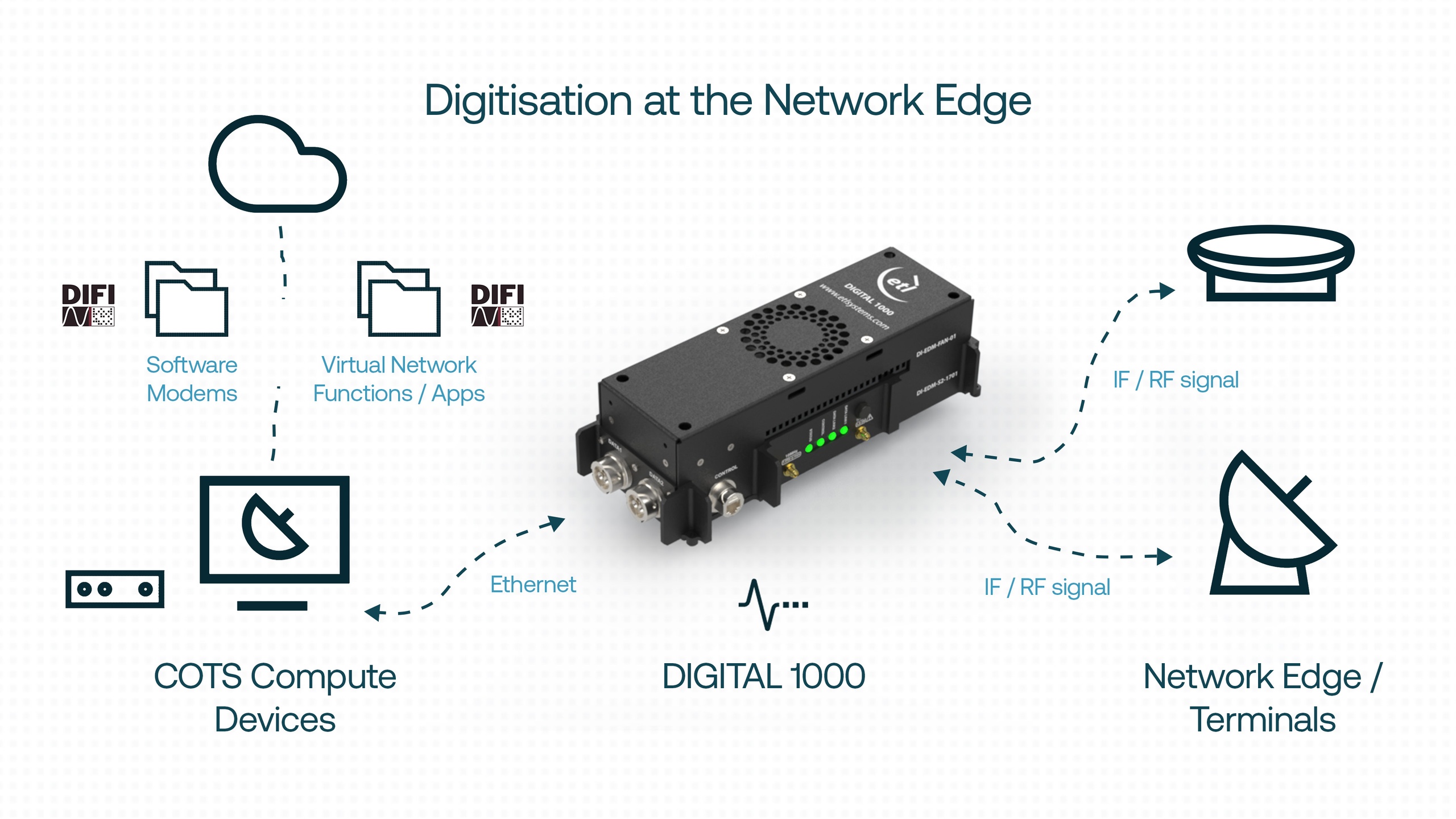
The shift to Digital IF, also known as ‘RF over IP,’ unlocks one of the most transformative aspects of modern satcoms architecture: the ability to run modem functions as pure software, instead of relying on fixed‑function hardware appliances. Through digitization, operators can deploy software‑defined modems and Virtual Network Functions (VNFs) that can be executed on scalable commercial server infrastructure, whether on-premise or cloud-hosted.
When DIF streams are delivered over IP, these functions can be instantiated dynamically wherever a server is available, in a data center, at the network edge, or even in a cloud environment. This decoupling brings several advantages:
• Elastic scaling – Modem instances can be spun up or down based on traffic demand, mission profile, or service-level requirements.
• Rapid waveform updates – New features, standards, or optimizations can be deployed through software updates rather than hardware refresh cycles.
• Resource pooling – Compute resources can be shared across multiple missions or customers, improving utilization and reducing cost.
• Geographical flexibility – Processing can be moved closer to the user, closer to the gateway, or centralized for efficiency, depending on operational needs.
VNFs extend this concept beyond the modem itself. Functions such as routing, encryption, traffic shaping, and performance monitoring can all be virtualized and orchestrated through standard frameworks.
In short, software modems and VNFs turn SATCOM from a hardware‑bound system into a digital service‑oriented platform, enabling operators to innovate faster, deploy more flexibly, and respond to mission demands with unprecedented agility.
While adoption of DIF has been gradual, the momentum is undeniable. Recent interoperability achievements under the DIFI standard are paving the way for open collaboration across the satcoms value chain. The standard, an open IEEE-based protocol, provides commonality of packet formats and control flows, ensuring equipment from any vendors adhering to the standard can be interoperated.
This is a foundational step towards achieving a fully virtualized ground network backed by a competitive market, with all the commercial benefits that competition brings. As more modem vendors adopt DIFI‑compliant interfaces, the ecosystem becomes increasingly modular, enabling operators to select best‑of‑breed capabilities rather than being locked into a single hardware stack.
DIF at the Edge
Until now, most DIF deployment scenarios have been focused on the gateway or control room; large installations with high-power, high-bandwidth infrastructure already in place, or achievable in the near-term. ETL Systems is working to push the technology further.
“Making this technology future-fit means enabling true multi-X operation – waveform agnostic, multi-orbit, multi-constellation – across any network environment,” explains Simon Swift, Engineering Director at ETL Systems. “To support tomorrow’s dynamic constellations, the ground segment must be equally agile and responsive. A static network can’t serve a dynamic space segment effectively.”
Modern edge terminals are on the cusp of incorporating virtualized modem software alongside a DIF digitizer, effectively transforming the terminal into a flexible, multi‑modem platform.
Instead of embedding a fixed hardware modem, the terminal can host multiple virtualized waveforms, each instantiated as needed to support different networks, missions, or coalition partners.
By digitizing the RF at the terminal, the same physical device can interface with a wide range of backend modem platforms i.e. government, commercial, or coalition without hardware swaps.
This creates a true PACE (Primary, Alternate, Contingency, Emergency) communications posture where users can switch waveforms, networks, or service providers dynamically, using the same terminal, simply by loading the appropriate SDR profile.
The result is a new class of agile, software‑driven edge terminals that reduce hardware burden (of both in-service hardware and the logistics of managing spares/maintenance), increase mission resilience, and give tactical users unprecedented flexibility in how they access satcom services.
Digitizing at the edge will provide game-changing flexibility and speed in rapid-response applications such as disaster recovery. It also delivers a cost-effective and scalable upgrade/digital transformation path for small gateway environments, removing the need for resource-heavy infrastructure investment.
One DIFI Consortium use case describes a defense network where rural antennas stream via encrypted IP to urban facilities that host the modems, VNFs, and encryption engines. The city sites then forwarded digitized and secured data, preserving encryption in approved zones and avoiding interference caused by 5G carriers.
Specifying an Edge Digitizer
Edge systems must meet three core requirements:
• Low SWaP: compact, lightweight, and energy-efficient for mobile or field deployment
• Low cost: cost-effective even at scale
• Environment: suitable for the deployment environment, as the digitizer becomes closer to the antenna.
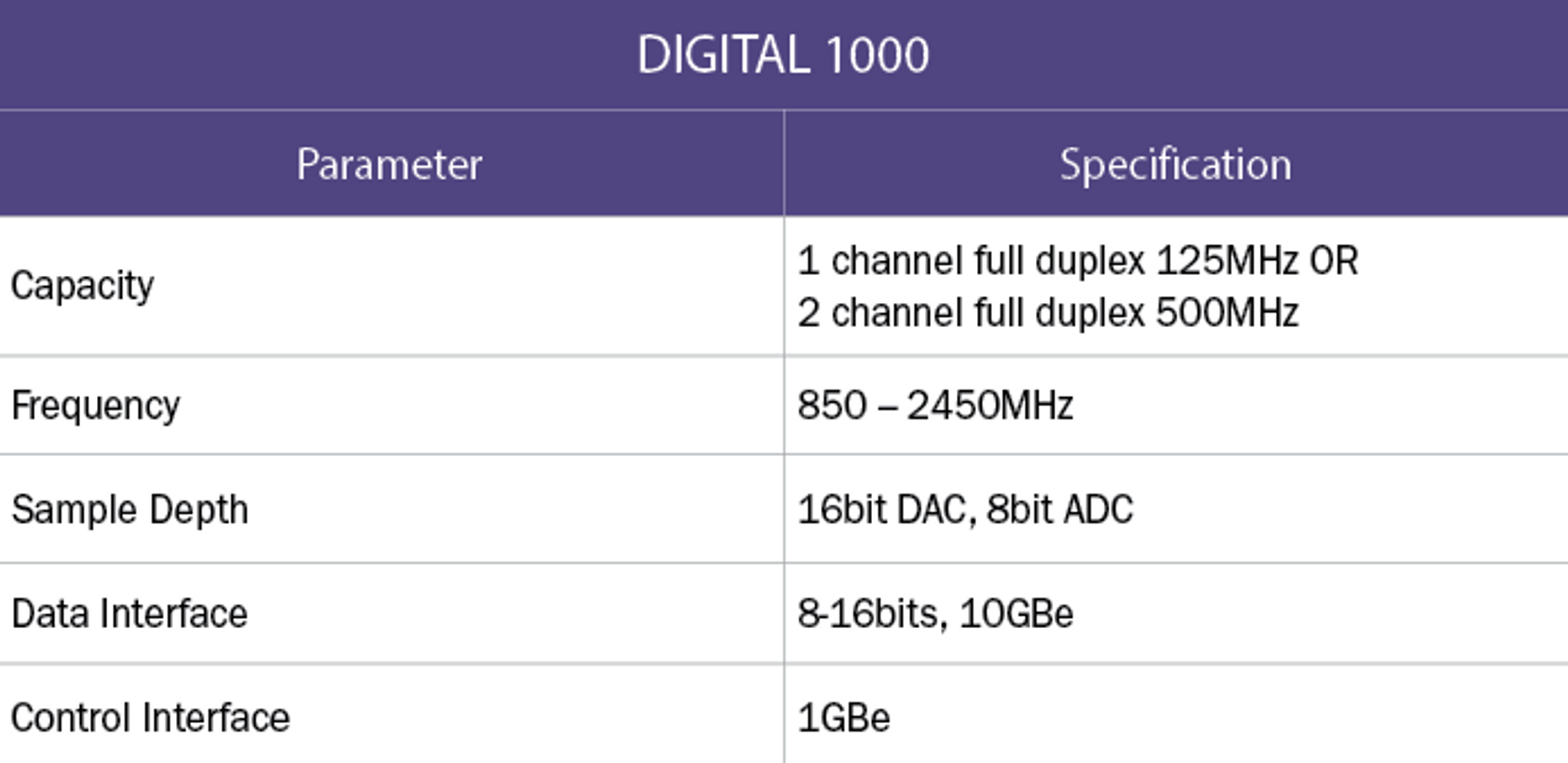
In addition, it is important to consider the bandwidth requirements of the Edge application in question. For example, a digitizer supporting a cellular backhaul will require significantly more bandwidth (both in terms of RF bandwidth and terrestrial network bandwidth) than one supporting just a single user.
Introducing DIGITAL 1000
Building on the success of its GENUS DIGITAL 5000 gateway digitizer, ETL Systems has developed DIGITAL 1000, a new edge digitizer that realizes the benefits of Digital IF in constrained and mobile environments.
While ETL’s rack-mount unit demonstrated the performance potential of RF-over-IP over 100 GbE, the required infrastructure is rarely available in tactical or mobile applications. DIGITAL 1000 takes this capability and repackages it into a ruggedized, modular form factor. The unit is optimized for field deployment and can operate across a variety of COTS compute platforms.
By facilitating digitization at the terminal, DIGITAL 1000 enables ground segment virtualization, bridging the gap between legacy RF hardware and emerging cloud-native satcom infrastructure. It supports flexible IP routing and software-defined signal management, ensuring operators can evolve their systems without resource-heavy hardware replacement.
The Road Ahead
As ETL Systems CEO Kevin Dunne recently observed, “Flexibility and modularity will define the next generation of ground networks.” DIGITAL 1000 delivers both, allowing operators to transition towards virtualized, interoperable architectures on a piecemeal basis, rather than requiring a total shift in infrastructure and resourcing.
The ground segment is at the threshold of wholesale transformation, with unprecedented industry alignment around open standards such as DIFI and an accelerating shift towards cloud-based operations. Convergence with non-terrestrial networks (NTNs) and geopolitical instability are only increasing this drive, as nations seek to ensure secure and reliable sovereign communications capability.
ETL Systems are supporting this transition by extending the benefits of digitization beyond the gateway and into every part of the network. With DIGITAL 1000, that transformation is well underway, making the virtualized ground segment a reality from the control room to the edge.