




Via’s Rising Stars Talk the Future of Our Industry
December 2nd, 2025
The satellite industry has seen an unprecedented scale of change over the last few years. It is also an industry full of bright young minds who believe that space can shape a better life on Earth. Via Satellite’s 2025 Rising Stars feature in August put the spotlight on some of the young professionals shaping the future of the space and satellite industry.
When looking at the future of the space and satellite industry, who better to talk about it then some of the 2025 Rising Stars?
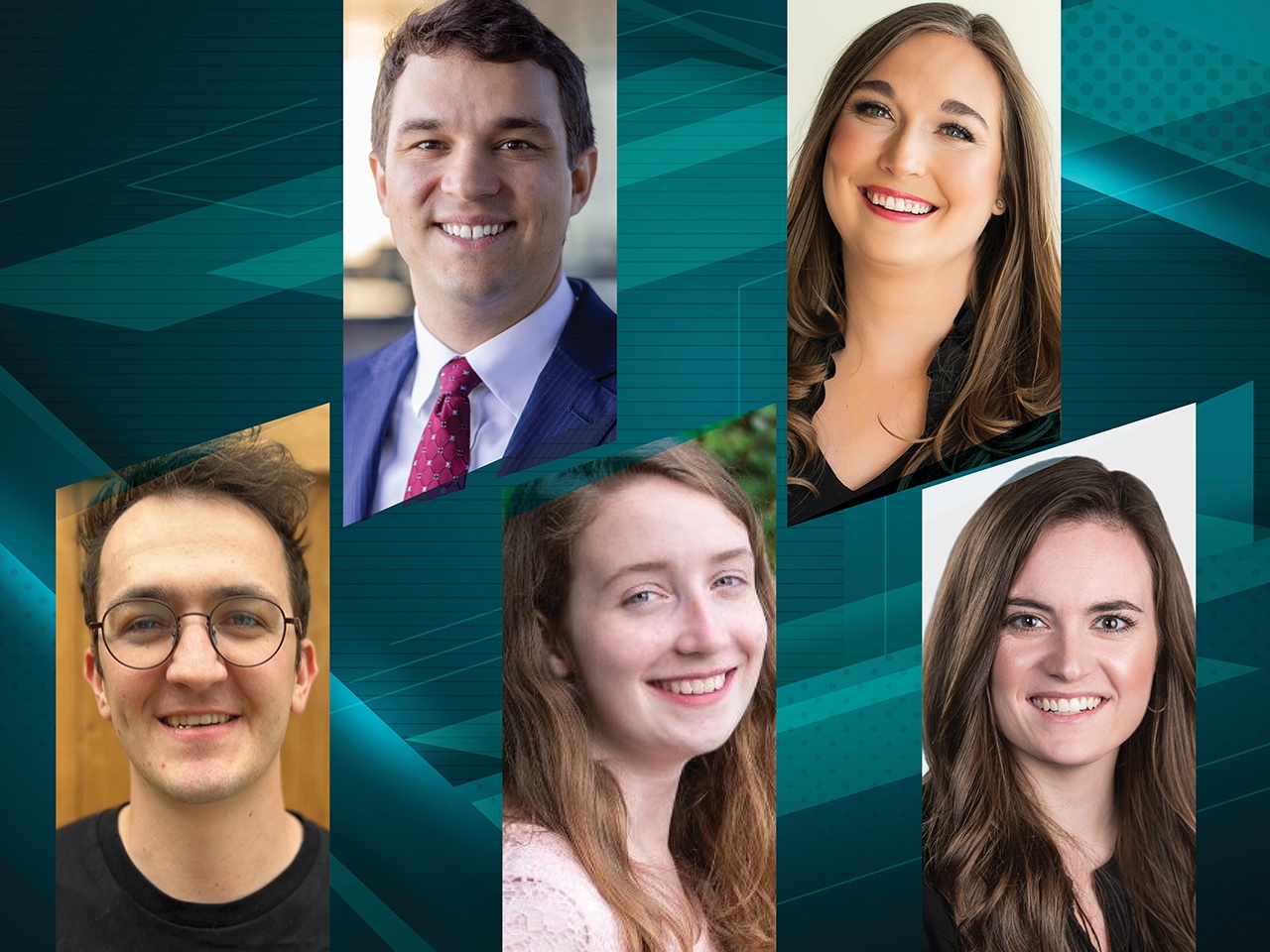
Taking part in this roundtable are: Ray Allensworth, spacecraft program director for Firefly Aerospace; Chris Balch, associate at Milbank LLP; Emma Cain Louden, president of Slooh; Grace Ochs, spacecraft systems engineer for Terran Orbital and Frederik Schoofs, FPGA engineer for ST Engineering iDirect.
VIA SATELLITE: Can you give me one major prediction of something that will happen in the space industry over the next five years?
Balch: I anticipate a wave of consolidation within the space industry over the next five years. In response to changes in global supply chains, industry players will seek dynamic partnerships to access the benefits of vertical and/or horizontal integration, which in turn will create significant demand for innovative debt and equity financing solutions.
Ochs: I think (and am hopeful) that we’ll see a rise in larger programs dedicated to clearing space junk. It has been at the edges of the industry, but I think more visibility on the issues and need may drive more big names stepping into the field.
Schoofs: Over the next five years, I think satellite ground systems are going to fully embrace cloud-native architectures. This shift will make scaling in real-time possible and reduce the need for so much hardware, which is a huge win for flexibility. Another big change will be multi-orbit satellite networks becoming the norm. Seamless switching between Geostationary Orbit (GEO), Medium-Earth Orbit (MEO), and Low-Earth Orbit (LEO) is going to optimize performance in ways we haven’t seen before.
VIA SATELLITE: At recent events, there has been a lot of talk around direct-to-device (D2D) and the potential of this market for satellite. What are your views on this market as well as the possibility of satellite technology becoming mainstream in this way?
Balch: D2D has enormous potential. I expect that it will especially accelerate growth in geographies such as archipelagos and remote areas where traditional telecommunications infrastructure is not as commercially viable. Also, I am hopeful that it will enable a variety of IoT innovations that would not otherwise be possible without a truly global coverage footprint.
Ochs: As expected, Starlink is leading the front of this effort, but I believe this will become a highly competitive field, where mobile companies have their own constellation providers, like T-Mobile has done with Starlink.
VIA SATELLITE: What kind of future do you think GEO satellites have? Is the world going to go completely LEO and MEO?
Balch: GEO will continue to be relevant, especially as lower orbits become more crowded and susceptible to the risks of orbital debris. I expect that integrated, multi-orbit architecture systems leveraging the efficiencies of GEO, MEO, and LEO will present robust and lasting opportunities for the satellite industry.
Ochs: I think GEO will always have its own necessary applications, but the drive to LEO and MEO is driven mainly by affordability. If rocket rideshares start providing GEO insertions at similar cadences/cost, I think we’ll see a levelling out across orbits.
Schoofs: GEO satellites are still going to play a critical role, especially for high-throughput coverage and things like broadcast and enterprise backhaul. But LEO and MEO are definitely gaining momentum because of their lower latency and scalability. I think GEO’s role will evolve as part of hybrid multi-orbit networks, where it complements LEO and MEO. Plus, with innovations like beamforming, dynamic bandwidth allocation, and virtualized ground systems, GEO satellites will stay relevant for a long time.
VIA SATELLITE: What do you think the next major revolution in the space industry and why?
Balch: Software-defined, multi-use satellites will be one of the next major revolutions. Expanded use cases for an individual satellite will create efficiencies as companies pivot strategies over time. It will also provide companies greater access to financing as their lenders take comfort in collateralizing a more liquid asset.
Louden: Science as a service. We're moving from monolithic, decade-long mission architectures to flexible, commercially-enabled platforms where scientists can iterate more quickly — and that fundamentally changes the pace of discovery.
The old model was built on scarcity. Launch capacity was expensive and rare, so every mission had to be exquisite, comprehensive, and correct on the first try. You wrote a proposal answering a specific scientific question, waited years for selection, then spent a decade building a custom spacecraft.
Science as a service breaks that constraint. It's accessible, flexible infrastructure that lets researchers interface more closely with commercial providers. The agility comes from decoupling the science from the infrastructure. You're not building a one-time exquisite mission — you're using platforms that already exist, that can launch multiple times, that can accommodate different instruments as your understanding evolves.
Rocket Lab's Venus Life Finder mission demonstrates this shift. MIT researchers identified a specific question about organic compounds in Venus's clouds and integrated one instrument onto an existing Photon platform to be launched in 2026. If the data reveals something unexpected, they can plan a follow-up mission on a similar timeline instead of waiting another decade for the next Venus mission opportunity.
The government still has a critical role in funding the ambitious missions, supporting the fundamental research, providing patient capital for the platforms that enable this marketplace. But the day-to-day work of iterative science can happen faster. That's the revolution: moving from science as a once-in-a-career bet on a single mission to science as an iterative process where you can respond to what you learn more quickly.
Ochs: If more companies get a foothold into the rideshare business and can compete with SpaceX on reliability and cadence, that will be the next biggest step for our industry as a whole.
Schoofs: The next big revolution is going to be the full virtualization of satellite networks. Moving to as-a-service models will make satellite capabilities way more accessible and flexible. On top of that, the shift from hardware-centric to software-centric satellite design will speed up deployment cycles and make it easier to adapt to new demands. It’s an exciting time to be in this industry.
VIA SATELLITE: If there is one thing that you think the space/satellite industry could do better, what is it, and how would you change things?
Allensworth: I’d like to see more industry collaboration with non-traditional partners. Oftentimes, looking beyond the aerospace industry allows us to find innovative solutions to some of our biggest challenges in space. As an example, during Firefly’s first mission to the Moon, our team partnered with a vision navigation company that had roots supporting autonomous operations in the farming industry. We took their proven technology and applied it to cislunar space and the lunar surface to perform autonomous hazard avoidance and visualizations, which helped enable us to successfully land on the Moon. This was a very non-traditional path through a non-traditional vendor that ended up becoming the baseline for how we perform autonomous visualizations moving forward.
Balch: The nature of the space industry depends on individuals from a variety of disciplines collaborating to achieve what otherwise would not be possible singlehandedly. We have so much potential to unlock greater innovation by connecting with and learning from each other, especially from those outside of our own disciplines.
Louden: We need to talk honestly about what we do and who we want working for us. The space industry has a storytelling problem. We've relied on astronaut inspiration and rocket launches to recruit talent, but that narrative completely misses what most space industry careers actually look like. We don't need a generation of kids dreaming about spacewalks—we need a generation that understands that satellite operations, data analysis, systems engineering, and policy work are where the real action is.
I've watched brilliant students walk away from space careers because they thought you needed a PhD in aerospace engineering or had to become an astronaut. Meanwhile, the industry desperately needs people who understand remote sensing, can write regulatory frameworks, know how to manage complex supply chains, or can translate technical capabilities into business value.
Here's what I'd change: Stop marketing space as extraordinary and start showing it as essential infrastructure. Talk about the day-to-day work. Highlight the data analysts, the operations teams, the project managers. Show students that caring about climate change makes them qualified for Earth observation work. That loving puzzles makes them great at orbital mechanics. That wanting to solve real problems is exactly the qualification we need.
And let's be specific about pathways. Not "study STEM" — but "here's how your biology degree translates to life support systems" or "your communications major prepares you for space policy." The talent is out there. We need to tell them clearly what we're building and why they are right to help us.
Schoofs: I think the industry could do a lot more to encourage cross-industry collaboration. For example, if telecom and space worked more closely together, we could accelerate innovation in ways we haven’t even thought of yet. There’s so much potential when you bring different industries together.
VIA SATELLITE: Given the amount of satellites that are being launched (tens of thousands), do you feel that industry is somewhat sleepwalking into a potential disaster for space situational awareness (SSA) issue?
Balch: I think there is significant potential for companies to step up to meet this challenge, and I am hopeful that innovation will be able to mitigate some of the effects of lurking potential disasters. International cooperation across all of the relevant stakeholders will be essential to address SSA head-on.
Ochs: Yes! Space junk has been a growing issue in our field and if we don’t take steps to address it now, it will only continue to get harder to solve. We’re starting to see more close calls, so that is why I hope more players join the field to work on a solution.
VIA SATELLITE: What could be the gamechangers for the space industry over the next 10 years?
Balch: In-space manufacturing, multi-use satellite systems, orbital debris collection and a broad suite of fully re-usable launch vehicles would all be gamechangers for the industry. As the cost associated with deploying space objects decreases, so too does the time horizon for market disrupting innovations.
Schoofs: In the next decade, a few things are going to completely change the game. AI-driven satellite network orchestration and traffic routing will make operations way more efficient. We’ll also see satellite networks fully integrated into 5G ecosystems, which will open up a ton of new possibilities. And cloud-native ground systems that support multi-orbit operations will make managing these networks so much easier.
VIA SATELLITE: Do you think AI will fundamentally change the space industry?
Balch: AI will fundamentally change all industries, space included. For the space industry, the emergence of AI may be pivotal in reducing the cost and deployment times associated with space projects. Among other applications, earth observation and space situational awareness stand to greatly benefit in the near term.
Louden: AI will fundamentally change everything — including how we think, work, and ask questions. The space industry won't be exempt from this transformation.
In astronomy, we're already seeing AI identify exoplanets, classify galaxies, and process telescope data at scales impossible for humans. That's extraordinary. But the breakthroughs that moved our field forward didn't come from processing power — they came from someone asking a question nobody thought to ask.
As AI handles more of the technical heavy lifting, the premium shifts to epistemology. How do we know what we know? What assumptions are baked into our models? What questions are we not asking because the AI agents haven't been trained to look for them? The revolution isn't that AI will replace human judgment. It's that AI will force us to get better at distinctly human work: asking better questions, exercising ethical oversight, and staying curious about what we don't yet know.
Ochs: As AI becomes more prevalent in all industries around us, I feel it’s inevitable that AI will leave a mark on the industry, whether that turns out to be positive or negative. I think the potential to apply AI to improve algorithms based on a specific satellite’s performance/metrics could be an incredibly valuable application, but all AI applications should have serious considerations on implications and aftereffects before implementation.
Schoofs: AI is going to have a massive impact on the space industry. It’ll optimize things like link scheduling, spectrum allocation, and anomaly detection, making satellite networks smarter and more efficient. As multi-orbit constellations get more complex, AI will be key to managing all that dynamic traffic. It’s exciting to think about how much more advanced and capable our networks are going to become.
VIA SATELLITE: Finally, as we head into 2026, how would you view the current state of the space industry? What kind of stories do you think we might hear in the year ahead?
Balch: The private space industry is rapidly maturing. Following the success of several others in 2025, I expect to see additional space industry companies have IPOs. I also expect significant M&A activity as the industry continues to consolidate.
Louden: The story I'm watching most closely is the workforce story. The space industry keeps projecting explosive growth while struggling to fill current positions. From my work at BryceTech analyzing space industry trends and now building talent pipelines at Slooh, I see the disconnect up close. In 2026, we'll hear more companies announcing they're rethinking credential requirements, building their own training programs, and competing directly with companies that offer clearer career paths.
But here's the deeper challenge: the next generation is deciding whether space careers align with their values, and the industry hasn't given them a convincing answer yet. Students ask me constantly whether working in space means neglecting Earth's problems. They see climate change, food insecurity, and global inequality as urgent — and they're not wrong.
Ochs: I think right now we are looking at a large pivot in the industry as funding gets redirected, but I am hopeful the industry will rebalance to work not only on commercial and defense applications, but back to our roots at the forefront of science. VS
Photos: Clockwise from top left: Chris Balch, Emma Cain Louden, Ray Allensworth, Grace Ochs, and Frederik Schoofs