







The Move to Open Ground Systems: Has the Satellite Industry Fully Embraced an Open Approach?
December 2nd, 2025
For years, satellite conferences have been peppered with cyclical conversations concerning the alleged lethargy of the ground segment. Despite being rooted in more conventional technologies, the importance of satellite landing stations has ballooned in proportion to the expansion of the space and satellite industry, though they don’t share the same reputation for disruption and innovation.
Challenges around digitization and interoperability on the ground have grown fractious in a climate of rapidly advancing technologies that have motivated bold intervention.
Founded in August 2021, the Digital Intermediate Frequency Interoperability (DIFI) Consortium was created to coordinate the digital transformation of satellite ground systems in an attempt to counter the dangers of a disaggregated industry. Without meaningful direction, the market was in danger of missing out on a seamlessly coordinated and open set of systems.
“DIFI solved a real pain point,” Alix Rousseliere, senior consultant and ground segment specialist for Novaspace, tells Via Satellite. “Proprietary Digital IF formats were blocking interoperability, which not only resulted in vendor lock-in but also limited teleports’ capacity scaling and slowed the move towards virtual and cloud solutions (because of non-standardized interfaces). DIFI has unlocked multi-vendor digital ground opportunities that would not exist otherwise.”
Waveform Architecture for Virtualized Ecosystems (WAVE) is a similar effort. Interventions like these have addressed a growing consumer demand by integrating configurable products into ground systems, which have proven foundational to decoupling hardware and software, enabling modular, software-based architectures.
Impressions from the Ground
These achievements haven’t been willed into existence by the ambitions of the consortium; they’re thanks to companies that have taken on the challenge and carved out a path forward through innovation and compromise.
“Having a much more standardized interface to acquire, monitor, and demodulate signals is a huge advantage,” Alvaro Sanchez, CEO of Integrasys, tells Via Satellite. “It has also helped accelerate our time-to-market with new digitizers such as Everest and other U.S. and European brands.”
Daniel Gizinski, president of Comtech’s Satellite & Space Communications Segment, agrees with the utility of flexible and configurable products.
“In principle, [open standards] allow users to access multiple satellite constellations, gateways, and associated ground networks—enabling the kind of connectivity resiliency that is essential for mission-critical defense applications and increasingly valuable for high-end commercial use cases,” he explains. “While DIFI will continue to evolve, its current version already delivers the essential signal transport capabilities needed to support next-generation digital ground architectures.”
Gizinski also notes that some major defense organizations are beginning to procure next-generation hardware built around the DIFI standard, pointing to Comtech’s contract for the U.S. Army’s Enterprise Digital Intermediate Frequency Multicarrier (EDIM) modem.
He emphasizes that software-based systems aren’t the end goal in and of themselves, but a means to enable customer needs for flexibility, adaptability, and speed. Comtech is also committed to open waveform standards like DVB-S2X and EBEM, which will influence their next portfolio of products.
The diversity of companies being brought to the table by standards conversations, including historically entrenched competitors, appears to illustrate what Novaspace’s Rousseliere describes as a “collective recognition of an open, interoperable, and multi-vendor future in the ground segment.”
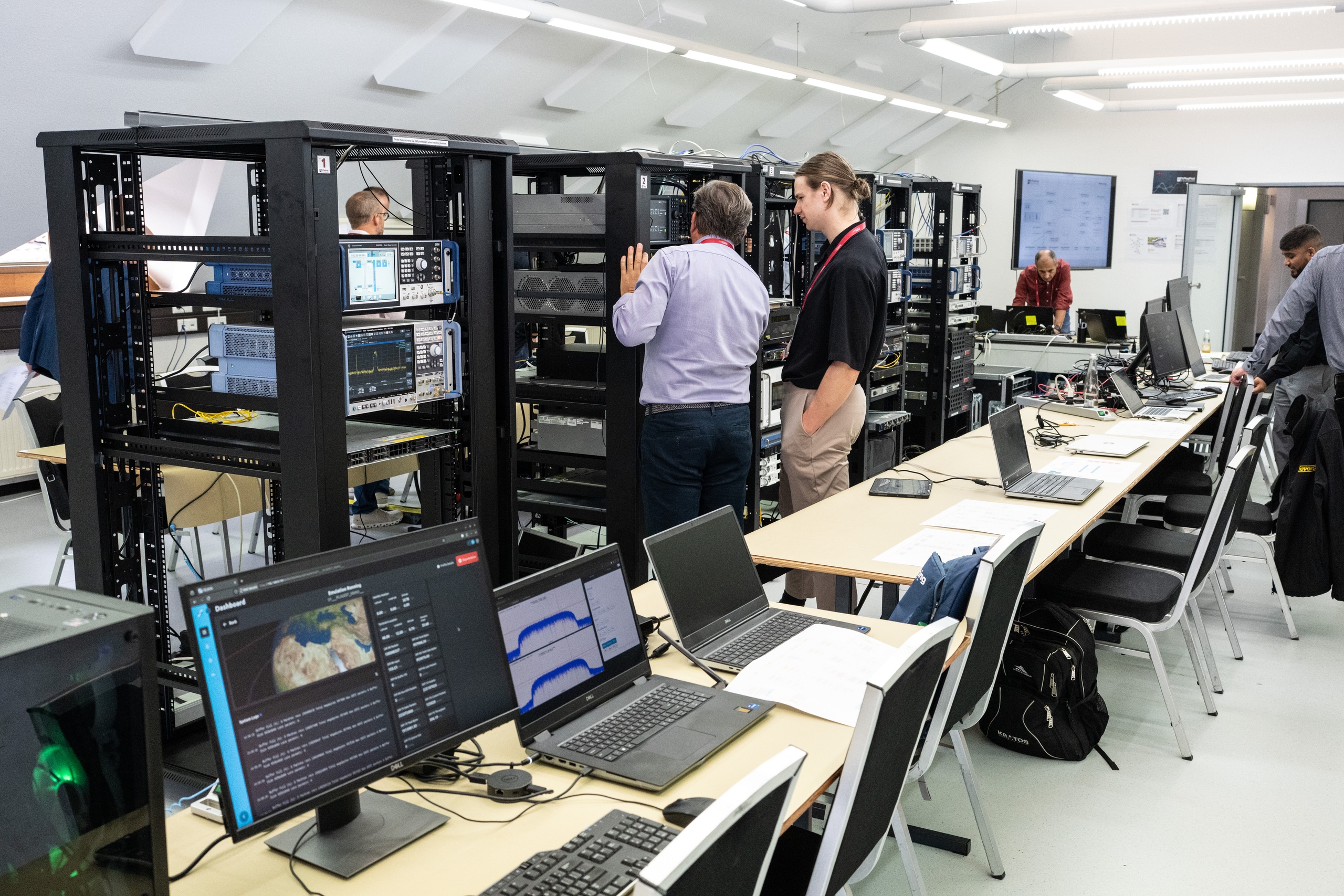
She commends DIFI’s “Plugfest” events, held since 2023, designed to put developers’ interoperability chops to the test and launch new DIFI-compatible products. Plugfests take place after the release of an issue of DIFI specification, giving manufacturers time to adopt new functions in time to prove their mettle at the event. These specifications are backwards-compatible with prior releases by design in the interest of layering new functionalities on top of those existing.
The strong attendance at these Plugfests are the best evidence of buy-in from players across the industry, claims Simon Swift, director for Digital Technologies at ETL Systems and chair of DIFI’s Specification Working Group.
“The demand is certainly starting to gain traction,” he tells Via Satellite. “This is still a nascent technology and will truly take off when a number of options for each part of the required system infrastructure are available from a multiplicity of vendors – we aren’t quite there yet, but we are heading that way.”
DIFI’s Specification Working Group (SWG) has a packed roadmap ahead of it, spanning enhanced time division multiple access (TDMA) to antenna control.
Evolving Open Technologies
These standardization efforts aren’t only about regulating technologies; developers have also cited them as the spark fueling new innovation at their companies.
Sanchez describes the standards as a catalyst for introducing digital twin and advanced monitoring capabilities at Integrasys. He predicts that more virtualization with a focus on optimizing data packet size, efficient channelization, and narrower bandwidths will be tackled in the next phase of standards. “Our goal is to remain fully agnostic and aligned with open standards, which brings a significant advantage,” he says.
It’s this evolving understanding of digitized waveforms that has convinced ETL’s Swift of an oncoming growth in signal processing applications.
“Once people see the benefits of a high-fidelity, accurately timestamped signal in the digital domain, digital signal processing and software companies will find new and innovative ways of processing the data,” he predicts. “Functions such as interference excision are just one example of this, but the ability to further process received (and transmitted) signals to improve the performance of hardware will enhance network functionality and performance.”
Swift insists these developments aren’t a cliff edge, with a sudden fatal pitfall awaiting analog users that haven’t been as fast as their peers. Instead, it’s a phased process. ETL uses a hybrid methodology, where analog and digital technologies co-exist, which avoids trapping customers at stages of technological transition, ensuring a path forward while enabling longevity for existing equipment.
The Sovereignty Question
Aspirations of open systems may worry mission-critical procurers who have become convinced of a need for sovereign systems, designed not to be easily interfaced with, by near-peer rivals.
“We understand that for many defense customers, openness must coexist with secure, sovereign capabilities,” Gizinski tells Via Satellite. “One of the unique challenges in satellite communications is the dual-use nature of these systems, where a commercial TV broadcast might operate alongside a protected military waveform.”
The kind of resilience defense procurers are looking for will take wider deployments of digital ground infrastructure and greater automation in system monitoring, control, and service orchestration. Once these building blocks are in place, the industry will possess what Gizinski calls: “The foundation for truly transformative, multi-constellation next-generation ground services.”
Whether mission-critical or otherwise, the necessity of robust cybersecurity capability in these technologies cannot be understated.
“We expect to see greater focus on securing teleports, communications, and transmissions,” Integrasys’ Sanchez adds. “Leveraging standards as transport layers while adding extra layers of security will be critical to protect against potential attacks or interference from third parties and other nations.”
A High-Competition Market?
A ground segment powered by the coordination of open systems standards can serve as an alternative to billionaire-backed constellations Starlink and Amazon Leo, which have proprietary ground systems.
High-profile consolidations in recent years, such as those at Viasat/Inmarsat, Eutelsat/OneWeb, and SES/Intelsat, demonstrate a need to compete with the giants.“Legacy players increasingly recognize that they cannot compete on scale, but they can compete by building an open, modular ecosystem where different vendors interoperate through shared standards such as DIFI,” Rousseliere says.
Operators are motivated to assemble best-of-breed solutions instead of making their own stack harder to diversify from. This vendor lock-in has been a customer bugbear for years, which WAVE and DIFI have made a point to address.
“The agility of service this unlocks will be critical to competition,” says Swift.
Greater flexibility is one of the most powerful advantages legacy operators have in the face of vertically integrated models like Starlink and Kuiper.
“By leveraging existing assets through more open, interoperable ground architectures, incumbents can respond faster to changing demands and avoid being locked into proprietary ecosystems. This approach will be tested at scale in the near term through initiatives like the European Union’s IRIS² effort,” Gizinski says.
Industry players were approving of consolidation efforts among themselves, which would be a far blunter method of removing barriers to standardization goals. The emerging partnership between Airbus, Thales, and Leonardo, compiling Western European aerospace engineering power, was highlighted as a demonstrable collaborate-to-compete model.
“While it won’t fully counter the power of vertically integrated giants, [standardization] offers the rest of the industry a viable path to differentiation, flexibility, and long-term cost efficiency,” Rousseliere explains. “Many legacy players’ future competitiveness will increasingly depend on the success of this plural-vendor, standards-based ecosystem.”
How Has the Industry Performed?
The industry has been unanimous that initiatives like DIFI and WAVE are still in their early stages, with their greatest impacts firmly in front of them.
“There’s still a lot of inertia built into legacy systems and procurement models, which makes large-scale change slow,” Gizinski suggests. “That said, the formation of DIFI has been a meaningful catalyst. It’s laid the groundwork for more flexible, interoperable architectures. The next few years will be critical in determining whether the industry can accelerate and fully embrace the shift toward open, standards-based systems.”
A big challenge of the industry is in navigating a fragmented and risk-averse stakeholder landscape, with constraints in investment capital and a high-interest-rate environment slowing the pace of adoption and innovation. Another factor is the size of the network required to transfer and store signals, which requires a great deal of computing power, requiring rigorous optimization.
Rousseliere is well aware of the scale of the challenge ahead.
“Interoperability must be verified across a wide range of vendors and legacy systems, which requires robust compliance testing and certification,” she says.
She awards the industry a 7/10 for its efforts toward more flexible technology over the last five years, citing the clear shift in that direction, away from closed, proprietary stacks. She highlights ubiquitous adoption, and the maturity of certification and compliance processes across jurisdictions as sticking points that have held back a higher score.
In 2026, the progress of multi-orbit, multi-frequency, cloud-native, and digitized capability will continue to be championed, with wider conversations around automation and machine-learning concepts – ideal for scheduling, predictive maintenance, and dynamic resource allocation – being platformed. We can also expect the power of the ground stations-as-a-service model to be further explored, a solution uniquely reliant on significant interoperability.
The spiraling demands of ever more secure systems and sophisticated cybersecurity functions on connectivity providers are an article all of their own, characterised by the shocking capabilities of modern hackers, the relative inexperience of these existential risks across industries, and the scale of ensuing scandals when operations fall afoul of it all.
“As ground systems become increasingly software-defined, operators expect to mix and match applications, waveforms, antennas, and orchestration layers from different vendors,” Rousseliere says.
These rising expectations could certainly prove a rude awakening for ground players. While the pull factor of a more effective standard has convinced many leading companies to innovate, the push factor of being caught out by the normalization of advancing complexity will only become more painful as demands grow more urgent. VS