






In-Space Mobility, Maturing From Last Miles to Superhighways
April 7th, 2026
In the late 1960s, NASA began studying the principle of a reusable “space tug” system, as part of the Space Transportation System (STS), then envisioned as a crewed space vehicle with complex robotic limbs for seizing and interacting with spaceborne hardware. The tug, along with the rest of the STS was never funded, but succeeded in illustrating the technological principle of an interstitial space vehicle between the launcher and the satellite or space station, which interfaced and ferried assets in orbit.
Today, the destinies of these technologies have fallen to the entrepreneurial minds of private industry, which have produced all manner of orbital drones, primarily for space debris mitigation, and satellite life extension missions. These demonstrations have seen healthy success, inching the emerging world of in-space mobility forward, slowly but surely.
“We are still in the covered wagon and horseback stage of in-space mobility, and we need to rapidly transition to the railroad,” says Jeff
Thornburg, CEO of Portal Space Systems. Thornburg envisions his company leapfrogging the train analogy to field the multi-mission sports car on the freeway with its Mini-Nova and Starburst spacecraft.
Whether you’re a space geek or just a transportation enthusiast, many can agree that modern economies need efficient road vehicles and high-capacity freight networks. With lots of orbital transfer vehicle (OTV) demonstrations coming together in the next two years the in-space mobility market is on the path to exemplify these technologies.
Upward Mobility
Mobility in orbit generally refers to technologies influencing the position, attitude, and timing of a spacecraft, crucially affecting its proximity to other objects in space. Satellites have been able to self-propel for years, but the capability hasn’t always been universal to their design.
Dynamic space operations (DSO) is a relatively new term for defining the higher end of this mobility capacity, approaching military levels of agility and precision with mission-critical assurance. The term can encompass policy and insurance as well as the actual technologies in some conversations.
“Government briefings and white papers have laid out a clear definition that is rooted in military logistics required in all other domains,” Lauren Smith, program manager for In-Space Refueling at Northrop Grumman, tells Via Satellite. “Dynamic space operations are those which require a system to maneuver frequently and quickly to accomplish mission effects.”
Crucially, these functions are often defined by their reactiveness, evolving a spacecraft’s ability to adapt to the unforeseen, a critical capability given increasingly congested orbits, but also invaluable against the hypothetical action of unfriendly states amid the stars.
At its most basic, Smith suggests this maneuver capacity isn’t limited by the sophistication of thruster technology or navigation software, but simple access to fuel for the extent of a spacecraft’s life. Of course, repeatable and universal access to refueling necessitates a certain infrastructure in orbit, which, for now, resembles science fiction.
“We as a society are on the cusp of being able to deliver massive amounts of payload to orbit via Starship, and customers demand rapid movement to execute missions immediately, not weeks and months after launch,” Thornburg says.
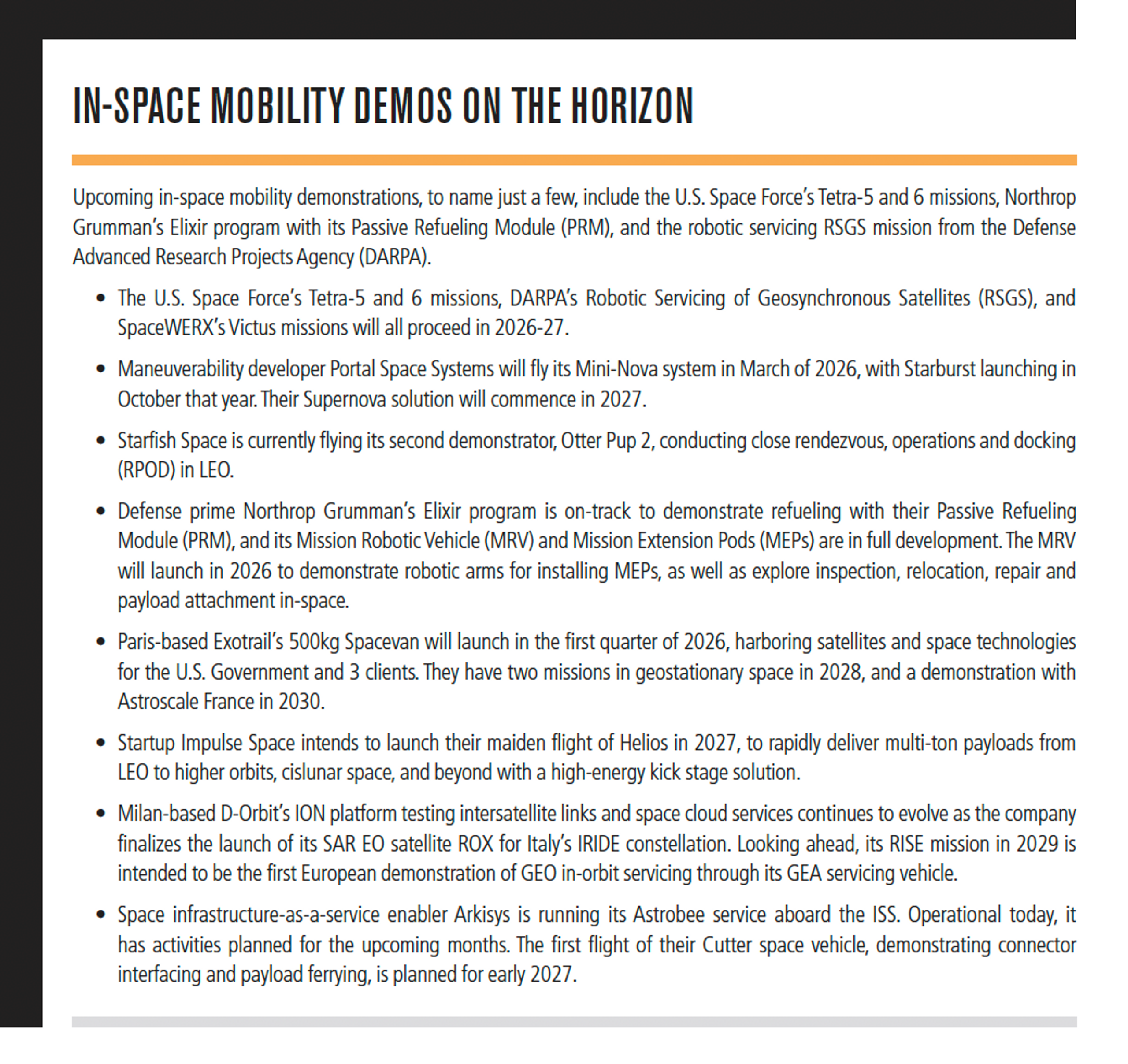
Northrop is known for breaking ground in this field following their landmark mission extension vehicle (MEV) missions, which first launched in 2019, the first of which recently completed its mission in April 2025.
“While the MEV-1 and MEV-2 missions were ground-breaking, there has yet to be an affordable and widely available solution such that a large portion of satellite operators can finally adopt these kinds of services and incorporate them into their fleet planning and strategies,” Michael Madrid, chief growth officer at Starfish Space, explains. “There needs to be technology solutions developed and proven that can do these missions at affordable price points and on practical schedules, so that in-space mobility is a reality that can actually scale.”
Starfish hopes to address this with their Otter OTV, one of several spacecraft seeking to become the workhorse of orbital servicing solutions.
Innovations & Demand Signals
In January this year, Hisdesat confirmed its Geosynchronous military communications satellite, SpainSat NG II, received unrecoverable damage following a mysterious “space particle” incident, still only loosely understood, wiping out hundreds of millions of dollars of satellite technology in a single blow.
In a world where damage like this can be examined and repaired, operators can sidestep a fundamental pitfall of the satellite industry, to say nothing of the kinds of regular servicing solutions to upgrade and extend a satellite’s natural operational lifespan.
“A single GEO satellite costs hundreds of millions to build and launch,” Matteo Lorenzoni, director of D-Orbit’s orbital access business unit. “Extending its operational life by servicing costs a fraction of the replacement price.”
Today, the necessity of demonstrations subsidize the costs of satellite servicing. In a world where this technology becomes reliable and high-quality, and its associated costs must be factored, prices would be under pressure to measurably undercut the price of a new model. There’s a reason people just buy new cars when a mechanic starts talking about a problem with the catalytic converter.
The use of rideshare tactics on OTVs could help with those costs, as Exotrail is experimenting with using its Spacevan system, bringing a proverbial bus to a struggle between cars, as only Europeans know how.
“Spacevan will be used as a ‘satellite carrier’ ready to get to the hot spots and deliver small satellites with capacities to intervene [in moments of mission-critical importance],” Jean Luc Maria, co-founder and CEO of Exotrail, says.
We’re starting to see the kinds of demand signals ambitious tech entrepreneurs can act upon for in-space mobility, but they’re still in their early stages.
“A robust, competitive mobility marketplace is likely still five to ten years away,” says Bryan Hoke, corporate technical fellow of dynamic space operation at The Aerospace Corporation. “Maneuver capability presents a classic chicken-and-egg challenge. Government hopes industry will innovate, while industry requires clear demand signals to justify investment.”
Keeping Mobility Open
Taking an orbital mobility market sector seriously means questions about the interoperability of technologies, questions around monopolies and state sovereignties, and democratizing access and competition arise. The topic drew the full diversity of perspectives from the executives Via Satellite spoke to.
“Avoiding monopoly capture requires what typically provides high growth from a wide variety and size of organizations, namely open standards, interoperable interfaces, transparent safety rules, and multiple access paths — so mobility doesn’t become a closed ecosystem controlled by a few large operators,” Dave Barnhart, CEO and co-founder of Arkisys, says.
Arkisys’ interest in port and docking technologies suits a plurality of vehicles and users, careful not to shut out SMEs, startups, and even universities. The deliberate establishment of accessibility centers the widest, most frictionless market, a mindset informed by their product, but some worry that such a philosophy smacks of regulation that can threaten value capture.
“Avoiding over-regulation or the enforcement of premature ‘standards’ on the industry will help ensure that a wide variety of innovative approaches can be tested and have a chance to grow into real businesses,” Starfish Space’s Madrid says. “Competition will be the best way to ensure products are developed, made accessible, and constantly improved in quality and affordability.”
All agreed now was the time to prove out the technology, putting developers to the test, serving some of the world’s highest value satellites, naturally forging bonds between territories in the process, which would foreground the kind of architecture that works.
“We need demonstrations to secure safe technology, commercial and insurance frameworks, as well as legal determinations between satellites that are not necessarily matriculated by the same States,” Exotrail’s Maria says.
The Aerospace Corporation’s Hoke says it’s precisely because maneuver requirements are driven primarily by national security goals and budgets, rather than pure commercial information, that the nature of maneuver and its technologies are still up for debate.
“Achieving maneuver capability will require deliberate strategy, architectural planning, and sustained investment driven by national security needs,” he says.
Sovereign Mobility
Part of this ironclad understanding around accessibility in space extends further to notions of sovereign control over the systems themselves for states in the thick of geopolitical concerns. Players agree that the national objectives of our unprecedented times have added significant demand for better, more comprehensive mobility across the 75 trillion cubic miles that encompass the bottom of LEO space to the top of GEO.
“Sustained space maneuver is fundamental to national security,” Hoke says. “It provides flexibility, unpredictability, resilience, and the ability to maintain advantage in contested environments. General [Stephen] Whiting and others have articulated the importance of maneuver through compelling operational analogies.”
This kind of capability came into sharp focus for militaries and governments after seeing evidence of Chinese satellites performing close approaches to Western counterparts since late 2023. During these years, three Shiyan-24A/B/C craft and two Shijian-6 05A/Bs performed coordinated flybys, and approaches of under a kilometer, either as a deterrence demonstration, or a set of live tests that have backfired politically.
In the future, functions like these could facilitate listening post operations, or even direct irruption through the use of illegal docking to damage, sabotage, or forcibly re-position a spacecraft.
“If we don’t protect and defend the use of LEO to cis-Lunar space for the use of the free, allied nations of the world, we will cede that high ground to our adversaries, which will deny our access,” predicts Portal’s Thornburg. “Rapid in-space mobility is required for us to compete against China for these locations and resources [beyond Earth].”
In light of the expansion of European investment into dual-use technologies to reinforce their mastery of crucial future technologies, some executives understood the continent to possess a more urgent context in the sovereignty conversation.
“The more productive question is what this means for European and allied capability,” D-Orbit’s Lorenzoni states. “The answer is straightforward: Europe must build and sustain its own operational in-space mobility infrastructure, not as a policy declaration, but as demonstrated industrial capability. Sovereignty is built by companies that build things, not by policy papers alone.”
For years, Europe has developed a reputation for grinding bureaucratic paralysis. A distinction the continent has taken pains to shake in the post-Liberation Day world. A return to the engineering excellence and world-leading determinism it lost in the 20th century won’t be easily reclaimed.
“The biggest constraint, and I would argue the biggest opportunity for U.S. and European collaboration, will be solving the full stack,” Arkisys’ Barnhart says. “Combining high-precision tracking, reliable propulsion, autonomous reliable space systems, and the operational doctrine to use all together safely.”
Certainly, talent and industrial capital span the West, but who gets to control the on/off buttons of these technologies will be decided by who can develop their own sovereign technologies, or be on the right end of their service agreements – all of which is yet to be determined. VS