




The Arctic Space Race Heats Up
Geopolitical, economic, and climate change dynamics drive the need for better satcom capabilities in the strategic Arctic region. January 20th, 2026
The race for space dominance continues shifting north to the Arctic.
Russia’s full-scale invasion of Ukraine in February 2022 significantly heightened European and broader Western interest in securing the Arctic. President Trump’s repeated calls to make Greenland part of the U.S. since returning to office further intensifies the stakes in the Upper North.
One thing all countries agree on: achieving Arctic security requires reliable communications, but extreme cold, vast distances and difficult terrain have made laying fiber or building towers impractical.
“The Arctic used to be a place called ‘High North, Low Tension’ — It was a place where people cooperated,” recalls Karen Jones, technology strategist in the Center for Space Policy and Strategy (CSPS) at The Aerospace Corporation, who has studied the region for the past eight years. “Since the invasion of Ukraine, there is a different model in play now — one with not just heated geopolitics but also heated geo-economics, as Arctic nations compete for the abundant natural resources.”
The world’s northernmost point, at the boundary of 66.5 degrees north and covering an area 1 and a half times the size of the United States, is home to 4 million people, including 15,000 Americans, 150,000 Canadians, 490,000 Norwegians, and over 2 million Russians.
“The Arctic is one of the most demanding environments on Earth: vast, sparsely populated, and defined by extreme conditions,” says Brigadier General Christopher Horner, commander of 3 Canadian Space Division, which supports Canada’s Arctic sovereignty monitoring, search and rescue and North American Aerospace Defense Command (NORAD) operations.
“Building and maintaining terrestrial fiber or cellular networks across thousands of kilometers of permafrost and shifting sea ice is prohibitively expensive and challenging,” Horner tells Via Satellite, citing magnetic anomalies and severe weather as factors that further complicate traditional radio communications, making dependable connectivity a persistent operational and safety challenge.
Despite these challenges, today’s Arctic is fast becoming a focal point for not only strategic competition and global trade but also a new frontier for extracting minerals and energy. A key driver is climate change: polar ice caps are melting four times faster than anywhere else on Earth. The melting glaciers have led to new maritime shipping routes, shortening the connections between Asia, Europe and North America.
Kjell-Ove Orderud Skare, program director for Space Norway’s Arctic Satellite Broadband Mission (ASBM), calls the ice meltdown “a multiplier for the climate changes in the Arctic,” which has intensified the need for understanding what is happening.
He cites commercial satellite imagery providers supplying the data to monitor the shift. “Tracking the changes that enable scientists and policymakers to keep a better watch on a rapidly evolving environment at the top of the world,” he says.
The rapid thawing has also led to a race to access the Arctic’s vast untapped oil, gas, and critical mineral resources, including rare earth elements, iron, nickel, copper, gold, diamonds, platinum, and cobalt. U.S. Geological Survey suggests that 13 percent of the world’s undiscovered oil and 30 percent of undiscovered gas reside in the region, with Russia’s Arctic regions particularly rich in gas.
The Geopolitical Landscape
The Arctic continues to be in international headlines with President Trump appointing a special envoy to Greenland, and escalating his calls to see the island become part of the U.S., citing national security. In mid-January, Trump threatened more tariffs on EU countries that oppose U.S. control of Greenland.
European leaders have been united in their opposition to such a move, warning it will end NATO. Trump has also repeatedly urged Canada to become the 51st state.
Unsurprisingly, Russia also considers the Arctic critical to its national security, economy and power, with the region occupying more than one-quarter of Russia’s land mass, according to a report by the European Institute for Security Studies. China has a high demand for imported energy and raw materials. It considers the Arctic of key importance for economic, scientific and strategic reasons, prompting China to self-proclaim itself a "near-Arctic state,” in a 2018 Arctic policy white paper.
Under the two countries’ Silk Road program, Russia has invested $300 billion in infrastructure, including icebreakers, vessels crucial for Arctic access, as well as ports and pipelines, to build a trade route via the Northern Sea Route.
The North Pole itself is in international waters, comprising the Arctic Ocean, adjacent seas and parts of eight nations — Canada, Denmark (Greenland), Finland, Iceland, Norway, Russia, Sweden, and the U.S.
“There’s a lot of missions in the Arctic that we have to do,” says Jones, citing border security, sovereignty protection, vessel assistance, oil spill response, fisheries monitoring, search and rescue, and science and research as examples.
“These activities will demand greater cooperation and connectivity as they continue to expand,” Jones and co-author Lina Cashin stated in their October 2024 paper, “Space-enabled Capabilities for Connecting and Collaborating in the Arctic.”
Significant Satcom Investment
The stakes in play in the Arctic are well understood globally, and especially in Canada, where nearly 40 percent of its land mass is considered Arctic and Northern. Its vast Arctic territory has given Canada the world’s longest coastline and a huge portion of the Arctic Archipelago.
As the Arctic’s importance grows, new Low Earth Orbit (LEO) and Highly Elliptical Orbit (HEO) satellites are poised to bring communications to a region long denied reliable, high-speed connectivity.
Canada’s Enhanced Satellite Communications Project – Polar (ESCPP) serves as one example of these investments. Designed to provide Canadian Armed Forces (CAF) with X-band, military Ka-band and ultra-high frequency (UHF) connectivity over the North Pole, the project is part of Canada's $38.6 billion modernization plan for North American Aerospace Defense Command (NORAD).
In December, Canada’s newly formed Defence Investment Agency selected Telesat and MDA Space to deliver a multi-frequency, Arctic milsatcom capability as part of the ESCPP.
“There’s a huge gap in quality communications in the Arctic today. ESCPP will be a vast, vast improvement for the CAF here in Canada, but also for their allies that are also operating in the Arctic, says Michèle Beck, senior vice president, Canadian Sales for Telesat.
While Telesat and MDA Space are currently working with the government to finalize requirements and the architecture of the future system, Beck told Via Satellite that the new system “will fill a gap where quality communications, low latency, broadband connectivity and secure milsatcom capabilities really don’t exist today.”
Beck confirmed that the system will support both narrow-band and wideband communications and likely operate across multiple orbits.
While the government set a 2035 deadline to have an operational capability, Beck said Telesat is optimistic it can deliver capabilities earlier than that date.
Military requirements clearly are driving satellite investments in the Arctic. Horner notes that imagery and sensing satellites deliver persistent domain awareness by monitoring ice conditions, maritime traffic, environmental changes, and illegal activities such as vessels operating without identification.
“These capabilities are critical for search and rescue, disaster response, and defense planning,” says Brig. Gen. Horner, adding that Positioning, Navigation, and Timing (PNT) systems are equally vital.
“High latitudes challenge reliability, and adversary jamming or spoofing can degrade signals. Resilient PNT ensures safe navigation for aircraft, ships, and ground forces, and underpins essential services like banking, logistics, and precision agriculture. Roughly 20 percent of Canada’s economy depends on space-enabled architectures, making these capabilities indispensable,” Horner explains.
LEO satellites are attractive for polar regions because their polar orbits provide full-Earth coverage, including the poles, unlike higher-orbit satellites that miss these areas.
LEO Service in the Arctic
Satellite operators see the Arctic as a key area to provide services.
For the last 25 years, Iridium has provided LEO satellite connectivity across the Arctic with its pole-to-pole satellite network.
“We’re still the only network covering 100 percent of the planet in real time,” notes Iridium spokesperson Jordan Hassin. The Iridium network supports remote monitoring solutions for armed forces and commercial shipping, including polar weather data collection and long-range identification and tracking of ships, as well as voice and data connectivity for individual users.
Telesat’s Lightspeed constellation, designed to serve enterprise and government users, is set to begin launching satellites at the end of 2026 with full global coverage, including in the Arctic, by the end of 2027, says Beck.
Eutelsat’s OneWeb LEO constellation has full polar coverage, says Eva Birgitte Bisgaard, president of the Connectivity Business Unit for Eutelsat.
“A LEO constellation covers the whole globe, but you will never have demand across the full globe. What matters is that we can provide capacity where people are,” explains Bisgaard, who formerly served as chief commercial officer for Maersk, manager of the world’s largest container fleet.
The Copenhagen-based executive says government interest in Eutelsat’s LEO offerings is growing throughout Europe as well as the Arctic because of increasing geopolitical tensions.
“We’re already delivering capacity where the users need it in Ukraine,” she says. Kyiv’s Armed Forces can activate Eutelsat terminals to support a specific military operation, explains Bisgaard.
She considers LEO satellites “critical” for covering the Arctic region, which lacks alternative connectivity options because of ice covering most of the land areas in and above the Arctic Circle.
One issue that continues to come up, says Bisgaard, who recently attended a NATO conference, is getting government procurement leaders to change their mindset from owning and building their own satellite capacity, to leveraging what exists today. Bisgaard says she hopes military organizations, which are heavily CapEx-oriented, begin to embrace service models like Eutelsat’s.
To address defense concerns for security and guaranteed coverage, Eutelsat offers priority-access connectivity and, if needed, dedicated points of presence (POPs). The company operates two satellite network portals, or SNPs, in the Arctic — the first in Svalbard and the second in Greenland. There, LEO satellites are the only option because “you can’t establish normal telco connectivity in those regions,” she says.
Eutelsat’s Arctic investments also include expanding its partnership with Tusass, Greenland’s national telecom service provider, to bring LEO connectivity to Greenland. The government of Greenland has banned Starlink since early 2024 to protect Tusass, the government-backed monopoly, which is legally obligated to provide service to all parts of the country, as well as to ensure data sovereignty.
Denmark’s decision hasn’t stopped Starlink from expanding to the High North. According to its availability map, Starlink service is available in Alaska, Canada, Iceland, and Svalbard, as well as Norway, Sweden, and Finland. It is not available in Russia.
Starlink satellites have supported the U.S. military in the polar region since 2022, according to Bloomberg.
In mid-2025, Starlink also put a particular focus on the polar regions, with a stated plan to launch 400 additional satellites to the polar inclination by the end of 2025 to improve service in Alaska and other polar regions.

Ground Station Growth
Arctic ground station expansion is also booming. Both Canada and Norway are investing in new stations. In addition, Astrolight, a Lithuanian space tech startup, is developing a laser optical ground station in Greenland through a partnership with the European Space Agency (ESA). The new system, being installed in western Greenland, will reduce reliance on traditional radio links while providing high-speed data transfer for polar-operating satellites and is scheduled to deploy at the end of 2026.
“To our knowledge, this will be the most northerly optical ground station in the world. It will provide better access to satellites in polar orbits that use this type of connectivity to download their data at higher data rates,” says Laurynas Mačiulis, co-founder and CEO of Astrolight, who estimates that the system will achieve 10 times more data throughput at 70 percent lower cost.
Mačiulis notes that the system is an alternative to RF and fiber comms that can be jammed or cut if they are undersea.
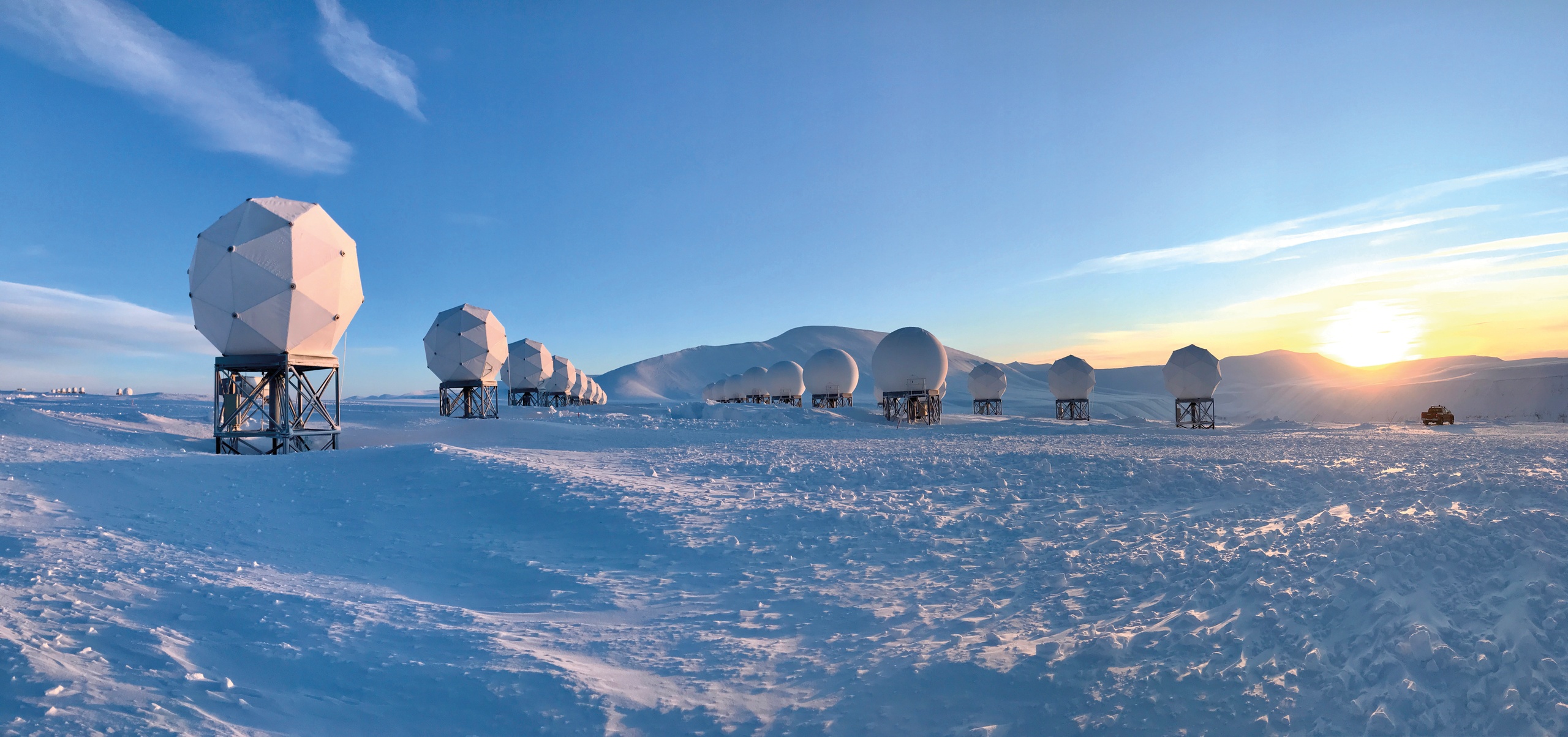
Greenland isn’t the only strategic site for satellite ground investment: Svalbard in Norway is home to the world’s largest ground station with over 100 antennas. The station, called SvalSat, has operated since 1997 under the management of Kongsberg Satellite Services (KSAT), a joint venture between Kongsberg Defence & Aerospace and Space Norway.
According to Jones, “Svalbard is in a magical location; it’s far enough south to see GEO satellites and also far enough north to maintain almost constant contact with polar-orbiting satellites.”
Norway’s governmental responsibility to track shipping activities in the Arctic came into stark clarity back in 2012, a few years after the launch of the country’s first Automatic Identification System for vessel tracking. Called AISSAT-1, it gave Norway its first view of shipping activities in the Arctic, showing that 80 percent of Arctic shipping occurs in areas under Norwegian governmental responsibility.
“That was an eye opener,” says Skare, a retired Norwegian Army major general and former NATO officer, now with Space Norway. The discovery underscored the need for robust search-and-rescue, fisheries control, and sovereignty monitoring. At the time, Skare recalls, the only capability for communications in the Arctic was low-bandwidth, high-frequency (HF) or Iridium satellite connectivity.
“To coordinate a search and rescue operation in the Arctic if a plane went down was a nightmare situation because of all the international air traffic crossing the poles both ways,” points out Skare, recalling earlier assessments of the Arctic concluding that the only capability missing was satellite-based broadband communications.
Space Norway, established in 2014, is a completely commercially operated government-owned entity.
“Norway is the only nation that has that model. Several nations are actually looking at it because they find it is an interesting way to ensure you can deliver capabilities that you can’t expect a commercial company to field,” he says.
That model continues as the company implements its Arctic Satellite Broadband Mission, or ASBM, a pioneering effort in military-commercial and international cooperation. The ASBM mission represents a near-seamless transition between satellites in Highly Elliptical Orbit and Geostationary orbit.
In August 2024, ASBM 1 and 2 spacecraft from Northrop Grumman launched from California’s Vandenberg Air Base into a highly elliptical orbit to reach the Arctic coverage area. The Space Norway-operated satellite system provides continuous broadband and secure communications across the Arctic, serving both Norwegian defense/civilian needs, and the U.S. Space Force through a secure payload. ASBM also carried an EU radiation monitoring payload designed to collect radiation-monitoring data.
Looking forward, Arctic nations and a diverse range of large and small space tech firms are working together to ensure that the region has a strong, secure communications infrastructure needed as geopolitical interest in the Arctic intensifies.
Reflecting on the “high-north, low-tension” cooperation enjoyed historically by Arctic nations, Jones acknowledges there are signs of strain, but she remains hopeful that cooperation will still be possible via organizations like the North Atlantic Treaty Organization (NATO) and the Arctic Council, an intergovernmental forum for cooperation on Arctic issues comprised of the eight Arctic states. She predicts that this spirit of cooperation will continue on issues like environmental monitoring, resource management and situational awareness.
“There’s a recognition that continued ingenuity – and especially collaboration – will maximize progress and efficiency in the region,” says Jones, underscoring that upcoming satellite constellations and broadband missions “will be pivotal.” VS