




Lite Coms Executives Talk Multi-Orbit Innovation and the Future of Tactical VSAT
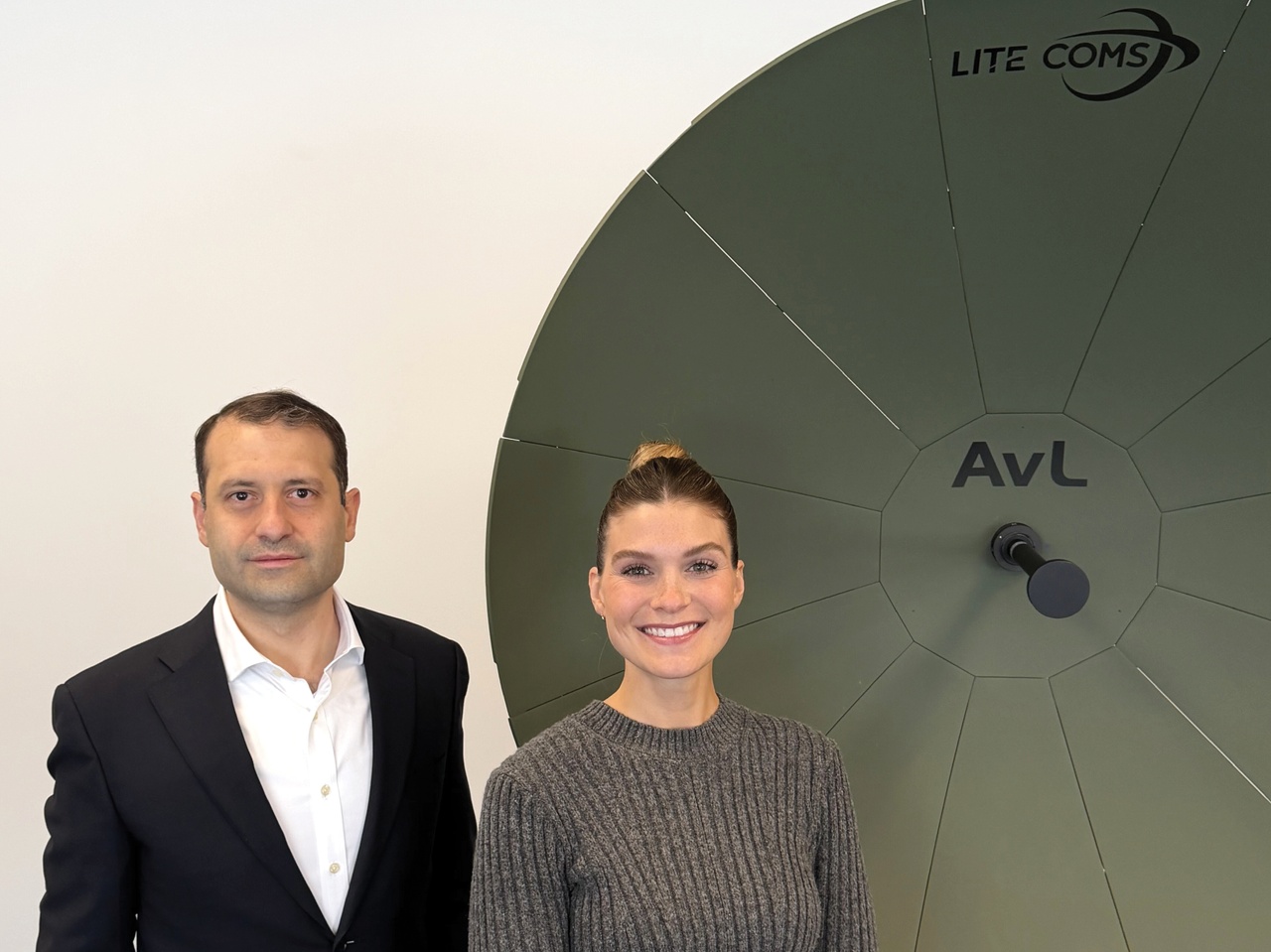
Lite Coms U.S. Army Sales Manager Gabrielle D'Amico and Vice President of Operations and Programs Andrew Colaruotolo talk to the company’s multi-orbit, multi-band tech roadmap and recent investments in production. March 17th, 2026
In less than seven years of operation, Lite Coms has established itself as a large player in the U.S. military VSAT market, with nearly 1,000 VSAT terminals deployed. At the core of its engineering philosophy is multi-orbit, constellation-agnostic connectivity. Lite Coms puts customer requirements at the center of its product design, and designs VSAT terminals to be deployed in the field within minutes.
Via Satellite interviewed Lite Coms U.S. Army Sales Manager Gabrielle D'Amico and Vice President of Operations and Programs Andrew Colaruotolo about the company’s multi-orbit, multi-band tech roadmap, how it's positioned for the U.S. Army’s Next-Generation Command and Control (NGC2) initiative, and its investments in production capabilities.
VIA SATELLITE: AS a VSAT manufacturer for militaries around the world, could you tell me about the range of products that Lite Coms offers? How many VSATs has the company deployed?
D'Amico: Lite Coms offers the industry's most comprehensive portfolio of tactical satcom terminals from a single manufacturer. Our product range spans from high-gain, flyaway VSAT and vehicular comms-on-the-quick-halt systems, to cutting edge ESAs, electronically steered antennas, based on comms-on-the-move (COTM) solutions. We are recognized as primary innovators in the VSAT and ESA marketplace. We maintain a competitive advantage by reinvesting a significantly higher percentage of revenue into satcom R&D, higher than our peers. That really sets us apart. Today we are approaching 1,000 tactical terminals deployed worldwide, supporting mission critical connectivity for global defenses.
VIA SATELLITE: What is your strategy for mult-orbit products? How do you support connectivity across Geostationary Orbit (GEO), Low-Earth Orbit (LEO), and Medium-Earth Orbit (MEO)?

D'Amico: That’s our bread and butter. Multi-orbit, constellation-agnostic connectivity has been our core engineering philosophy since our inception seven years ago. Our LiteSat 2.2 and LiteSat 1.3 are the pioneering systems of Lite Coms. These are the first two Wideband Global Satcom (WGS)-certified terminals to also achieve the SES O3b mPOWER MEO certification. The LiteSat 2.2 was certified in 2021 and has been operational across GEO and MEO networks for years. Our ESA product line also supports seamless transition between GEO and LEO constellations and has been in active production since 2022. Looking ahead, we're ready to disrupt the market once more in 2026 with our Ku/Ka, dual-band, dual-beam, GEO/LEO hybrid terminal, which is a comms-on-the-move product.
VIA SATELLITE: Can you tell me more about the upcoming hybrid terminal?
Colaruotolo: When we started Lite Coms, we had a mission to always offer multi-orbit terminals. Every product that we delivered to our forces had the capability to operate on multiple constellations. We started in parabolic antennas. In order to stay relevant and service the LEO orbit specifically, we knew that we needed to introduce ESA products. We started with a Ku-band ESA, because the SpaceX network that was launched first was Ku-band, and OneWeb coming online around the same time was also Ku-band. Looking into the future, we have Amazon Leo and other LEO constellations that are all Ka-based. The natural progression of things is to offer Ka-band systems as those networks reach their initial and full operating capacity over the next year or so.
Our philosophy is multi orbit, multi constellation, so once there are Ku- and Ka-band constellations both up in the sky, we want to offer a product that can hit both of those networks. Our goal is to offer a Ku/Ka-band, dual-beam, simultaneous terminal so that you can access many, many networks in one terminal. I feel like it is an earth-shaking innovation that our competitors are trying, and no one's done it. And we’ve demonstrated it on-the-air. No one else is doing it. People are trying — but no one's accomplished it.
VIA SATELLITE: Lite Coms has talked about the concept of an asymmetric approach to MEO. Can you explain this concept and why it’s beneficial?
Colaruotolo: Our LiteSat 2.2A was the first terminal to be certified for both WGS and O3b classic, and LiteSat 1.3A was the first WGS and mPOWER certified terminal. What we're hearing from our customers is that carrying two large antennas is a burden, both financially and logistically. With MEO offering very high data to rates and very low latency, it's a capability that can't be ignored. In order for them to use that capability and not overburden themselves, they want to take an asymmetric approach.
If you have a 2.2, you could add a 1.3 and still do a make-before-break link. Instead of having two of the same size antennas track those satellites and hand them off, you would have one large one and one smaller one. You can do that same handoff and get that high throughput, low latency link, but you don't have to use two giant antennas. It’s a one-of-a-kind solution that we have tested and proven as a proof of concept. We're currently working with our customers and network providers to productize this solution.
VIA SATELLITE: Lite Coms has a focus on rapid deployability. From the warfighter's perspective — why does that agility matter, and how does it shape decisions that the company makes in terms of product design?
D'Amico: In high pressure, contested environments, speed and survivability is a metric. Our design philosophy is centered on the expeditionary warfighter. We strive for customer delight by ensuring a soldier can achieve on-air status in minutes. We prioritize simplicity in human-machine interface. Every product undergoes “zero training” testing, in which individuals with no technical background, myself included, must assemble the terminal without a manual. The focus on technical agility ensures that satcom is a force-multiplier, not a logistical burden. We make it extremely user friendly, so that it's fail-safe. I am not an engineer, I didn't come from that background, and I can put together a LiteSat 1.3M in under 10 minutes and get it on-air.
VIA SATELLITE: LiteComs recently expanded its line of tactical satellite modems. Can you talk a little bit about this expansion and what capabilities you've added?
Colaruotolo: We treat our industry partnerships as a vital component to our satcom ecosystem. By collaborating with the leading modem of vendors, we stay ahead of the emerging and protected waveforms and the digital IF developments that are coming online in the next year. We acquire early prototypes for our engineers to do the mechanical packaging and do the software interfaces. When iDirect or Comtech comes out with a new modem, we want to make sure that we get those into our engineers’ hands before the general public release. This strategy has allowed Lite Coms to deliver the first fully integrated terminals for advanced waveforms on Geo, MEO, and LEO, and provides our end users with hardware that’s future proof. Our goal is to continuously deliver the latest and greatest technology and latest greatest hardware and software platforms to our end users.
VIA SATELLITE: So Lite Coms works with the waveform and modem vendors as well as satellite operators, collaborating across the value chain?
Colaruotolo: Yes, and it’s kind of an interesting business model. We're not technology creators — we're technology innovators. We take technology that’s built in labs and bridge the gap to our customers so that they can have the best emerging technology. But we also work to put it in the hands of 18 to 20-year-old users so that it’s field ready and they can actually use it.
D'Amico: Our design and our innovations are not because we think of it — it’s because our customers think of it. Our products are really designed by our customers and their feedback. Every iteration is because of what they have told us.
VIA SATELLITE: Along that line of being customer-centric, what are some of the shifts you're seeing in what military customers want from satellite ground technology providers?
D'Amico: There have been a lot of shifts lately. Modern military customers are demanding multi-constellation resilience, rapid setup, and long-term reliability. There is a major shift toward PACE (primary, alternate, contingency and emergency) planning that requires terminals to switch orbits instantly. At Lite Coms, we meet this demand by offering extended warranties that reflect our hardware's reliability. We also offer Lite Link, a super simplified graphical user interface (GUI) that’s used across all of our products. We've also optimized our supply chain to provide off-the-shelf delivery, ensuring readiness is never delayed by manufacturing backlogs.
VIA SATELLITE: How do you see Lite Coms supporting the U.S. Army's Next-Generation Command and Control (NGC2) modernization effort?
D'Amico: The NGC2 modernization goals align perfectly with our modular, open systems approach. Lite Coms supports the Army's move toward a data-centric, cloud-native architecture by providing the high-bandwidth, low latency transport layer required for cloud edge computing. Our strategy of rapid technology injection ensures that the Army can upgrade capabilities like moving from GEO to LEO without replacing the entire terminal, offering a high, affordable, and scalable path to the Joint All Domain Command and Control iIntegration. There are so many areas where Lite Coms fits into the NGC2 effort.
Colaruotolo: NGC2 is changing the acquisition strategy so that instead of having multiple programs of records that last for 10 to 20 years, there will be a technology refresh every five years. By the time the Army gets to the end of their fielding, they can start fielding the next technology. That aligns with how Lite Coms was built. In 2018, we started a company that was bringing new technology to the field without programs of record. We always say that we're a commercial company that just happens to sell to the government, not necessarily a government contractor. Lite Coms really fits the NGC2 strategy for modernization in that way, of not having programs of record and being a commercial company. We’re refreshing; we're obsoleting our own products every couple of years, which is exactly what the Army wants to do.
VIA SATELLITE: Is there anything you would like to see change in terms of how the Army fields capabilities?
Colaruotolo: We need to transform the way that the government trains and fields. We can build antennas all day, but if the military can't field it at that pace, then what's the point of building it at that pace? We have to innovate on the training and the support model. We've partnered with a number of companies that have made generative models that teach soldiers how to put the equipment together and how to get it on air, that they can access via their cell phone and can dramatically increase the pace at which equipment is fielded. Solving the other side of the problem is to actually get it into the user's hands and make sure that they're using it properly. We want to help create that groundswell. At the moment, the government is saying it will reform acquisition, but we also need to reform logistics.
VIA SATELLITE: Last year, Lite Coms added a new production facility in New York. How are you seeing demand grow, and how does the new facility help meet that demand?
Colaruotolo: Lite Coms has maintained exponential growth for the entire time that we've been in business. We have doubled or tripled in size, annually. Our new advanced manufacturing facility called our Satcom Campus in Victor, New York, was a strategic necessity to support this demand. Our facility enables vertical integration. It allows us to go from design to delivery at unprecedented speeds. In just the last seven months, we have successfully delivered over $100 million in revenue. We’re proving our ability to scale for large Army program of record requirements, and also to shift dynamically as demand shifts. As we see a surge in demand for ESA terminals or parabolic antennas, we can change our factory very quickly to manage those surges and deliver quickly.
D'Amico: Everybody wants things yesterday. Patience is a thing of the past. People worry about capacity and how many terminals can you produce per week — it’s not a problem for us. Our facility is ready for ramp up or ramp down. We're ready for the NGC2 production.
VIA SATELLITE: Looking three to five years out, where do you see the biggest growth opportunities?
Colaruotolo: We believe that growth will be driven by the massive expansion of the LEO megaconstellations and also the refresh of the traditional parabolic antennas in order to support, you know, new networks, and specifically the Ka-band high throughput satellites (HTS) and the MEO orbits. So we're seeing significant opportunities in providing resilient PNT and multi-domain operation support for both domestic and international defense partners.
In our first year business, we fielded six systems. This year, we'll have almost 1,000 antennas in the field. We’ve been ramping up very, very quickly and been able to sustain that exponential growth over nearly seven years in business. We’ve been able to handle that growth and increase our market share.
VIA SATELLITE: In a crowded market, how does Lite Coms differentiate itself from other VSAT providers?
Colaruotolo: At Lite Coms, we are the VSAT innovators. Our competitors are really relying on legacy logistical support for 10-year old tech. We weren't even around 10 years ago, so all of our equipment is innovative. We believe that the warfighter deserves the best equipment that is available today. We are developing R&D on our own budget, obsoleting our own product, creating new products, and delivering them as a commercial product. We're not on a trajectory with government programs — we're on a trajectory with technology.
We're also offering extended warranties. We're seeing huge groundswells where our customers are not looking for one- or two-year warranties. They're looking for much longer, five-year warranties. We're removing the risk of modernization so that they have support all the way through. At Lite Coms, we don't just sell the terminals, we provide the lifeline for the mission. Our tagline is, “Your mission is our motivation.”
D'Amico: Our product is like the “Chipotle of satcom.” You can plug and play, whatever modem, whatever band, whatever packout; we customize it to whatever the mission dictates.
VIA SATELLITE: We are a few weeks out from SATELLITE x GovMilSpace. What will Lite Coms’ focus be at the show?
Colaruotolo: Number one, we're introducing our Ka-band ESA and showing a prototype. That will be poised for Amazon Leo and the Space Development Agency network. We're also targeting MEO with that terminal as well.
We also have a couple of new tactical modem assemblies that we're introducing at the SATShow. Some circulating around MEO, some around GEO. We’ll also have our MRZR vehicle platform with our COTM antennas on it, as well as our X/Y full motion antenna. VS