


Industry Roundtable With '10 Hottest' Executives
Execs from the '10 Hottest Companies in Satellite’ for 2026 talk growth markets, defense demand, and AI adoption. March 17th, 2026

Heading into SATShow Week, Via Satellite interviewed the executives of some of the companies featured in our ’10 Hottest Companies in Satellite’ for 2026 to get their takes on some of the key issues facing the industry like increasing defense demand, the acceleration of AI technologies, and what markets they see as critical for growth.
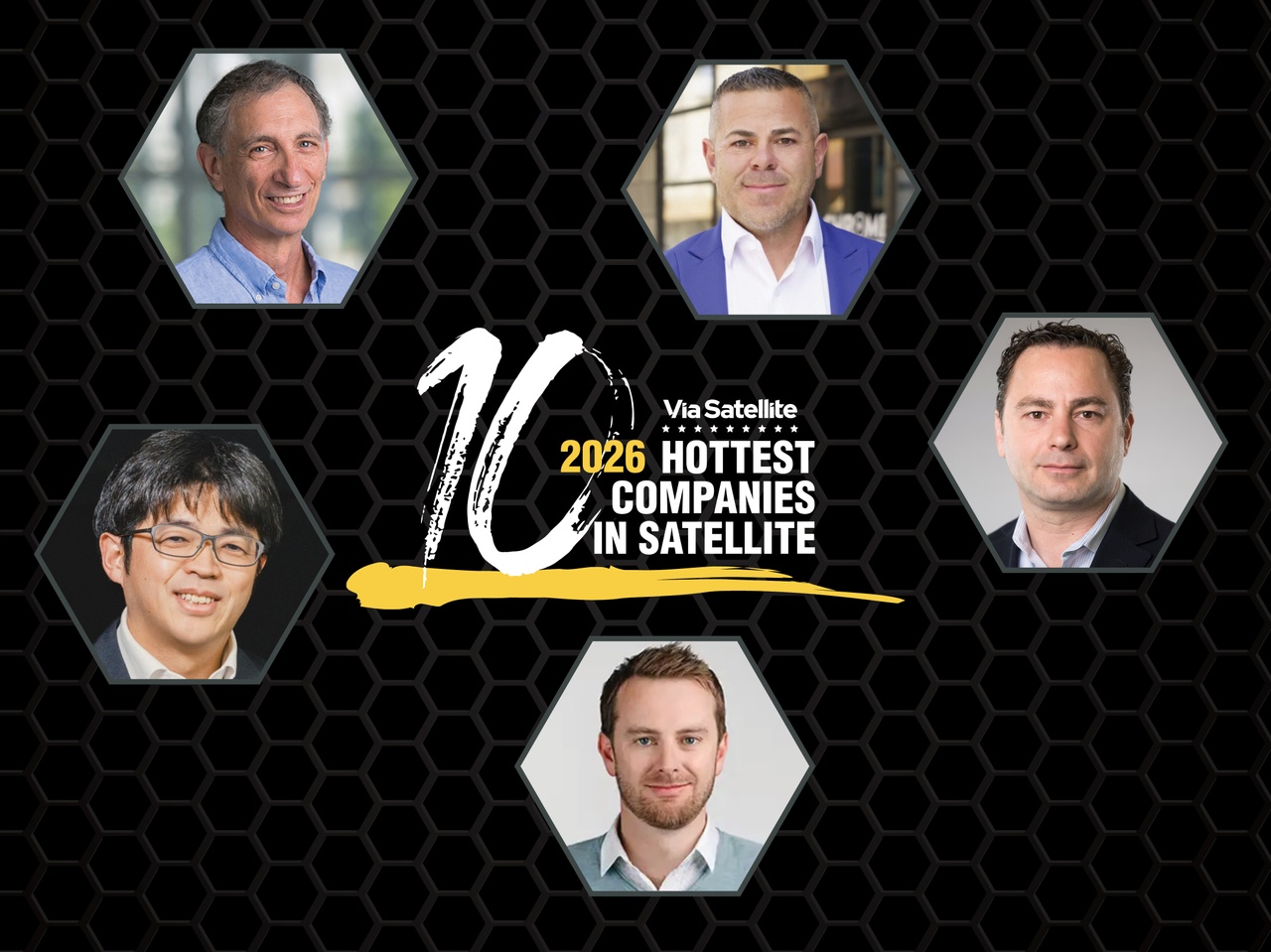
Taking part in this roundtable are: Mark Dankberg, chairman and CEO of Viasat; Massimiliano Ladovaz, CEO of SpinLaunch; Matt Magaña, president of Space, Defense & National Security for Voyager Technologies; Takayoshi Fukuyo, CEO of ArkEdge Space; and James Mason, chief space officer of Planet.
VIA SATELLITE: What do you expect to be some of the hot topics during SATShow Week 2026?
Dankberg: There is a tremendous amount of innovation happening across the space sector, and we expect several themes to be particularly prominent. Of course, while it’s been a central topic in recent years, we anticipate continued focus on the emergence and advancement of multi-orbit and hybrid networks. This includes the technologies, platforms, and partnerships that will enable seamless integration across orbits and deliver more flexible, resilient services. There is a lot of development and collaboration happening in this area and Viasat is right in the middle of it, so expect more conversations about that this year.
Second, we also expect heightened discussion around the importance of the role of dual-use space systems in augmenting sovereign organic systems and extending resilience to critical commercial platforms. This topic is gaining strong traction globally — especially outside the U.S. — as nations look to ensure diversity, choice, and greater self-reliance in the future space economy. There is of course the technological part of providing sovereign solutions but aligning regulatory and policy frameworks will also be an important part of these conversations.
Third, we foresee continued momentum and discussion around new and rapidly developing markets, particularly across advanced non-terrestrial network (NTN) services like direct-to-device (D2D) and Internet of Things (IoT) applications. These offerings will help bridge terrestrial and satellite networks, enabling more resilient and reliable connectivity for users.
Ladovaz: Firstly, I would say sovereign/defense-driven and public constellations. In my view this will be one of the dominant topics of conversation. Why? Governments are accelerating sovereign space infrastructure as a matter of resilience, cybersecurity and strategic autonomy. This is no longer theoretical, it is becoming policy.
Programs such as Europe’s IRIS², U.K. military and sovereign initiatives, and the growing national broadband ambitions across the Middle East, Asia, and Africa are putting real public capital behind the concept.
Secondly, a theme will CapEx efficiency and new technology architectures. This is not just a technology theme. It is a business survival theme. The industry knows that the classic Low-Earth Orbit (LEO), and not just LEO, model built on multi-billion CapEx and long deployment cycles is extremely hard to sustain. Capital markets have changed. Patience has reduced. Execution risk is being priced differently. That naturally pushes the conversation toward architectural models that materially reduce deployment cost and risk. You will not hear many CEOs say publicly that the old model is broken. But behind closed doors the discussion is clearly about capital efficiency, speed of execution, and how to reach positive unit economics faster. Investors are far less tolerant of open-ended CapEx stories and multi-year delays. They want discipline, visibility and credible paths to profitability.
The third theme is hybrid connectivity and the integration between terrestrial and satellite networks. Satellite is no longer a standalone layer. The question is how it integrates structurally with terrestrial infrastructure.
Magana: The conversation is shifting from “Can we launch it?” to “Can we operate it, protect it, and scale it?” AI-enabled space operations — from autonomous constellations to on-orbit edge compute.
Defense and space resilience — proliferated architectures, hardened systems, rapid replenishment. And commercial sustainability — manufacturing and delivery at scale.
Fukuyo: Firstly, I would say dual-use space infrastructure. Defense and security investments are now the primary catalyst for next-generation space infrastructure — and the dual-use opportunity this creates for commercial players is enormous.
Secondly, I would point to the AI-driven geospatial economy. The fusion of AI and satellite systems will create a new geospatial economy built on real-time data, automated analytics, and space-based digital infrastructure.
Finally, agile, software-defined constellations will be a talking point. The industry is shifting from hardware-defined to software-defined architectures. The winners will be those who can update, reprogram, and repurpose constellations in orbit, reducing costs and responding to demand in real time.
VIA SATELLITE: We are living in complex geopolitical times. How do you think this will impact the space market? Is this impacting where you are seeing the opportunities for the company?
Dankberg: Recent events and transactions underscore that macro geopolitical, economic, and technology forces are being driven by sovereign control of critical space and ground infrastructure assets including communications, sensing, and compute; dual commercial and national security uses; cooperative and coalition capabilities; NTN D2D augmentation of terrestrial networks for national security and commercial applications; vulnerabilities of terrestrial telecom infrastructure in contested geographies; and resilience to space and ground cyber and physical threats.
We also have the detailed understanding and expertise to help craft policy and technology solutions to ensure continued access to the spectrum and orbital resources needed for the world to participate in the rapidly evolving and emerging space economy. We note that many of the issues governing access to both orbits and spectrum are emerging as linchpins to doing so, and all that implies for national security interests, whether economic, physical or digital security. The pending European Space Act and European Digital Networks Act reflect rising awareness of these factors and policy responses. The U.S. government is also investing substantially in multiple orbits to enhance resilience for tactical national security communications.
Ladovaz: Absolutely, fragmentation drives opportunity. Countries want autonomy, not dependency. This is becoming more and more a central part of the customer conversations.
We’re seeing demand move away from wholesale capacity toward fractional ownership — where customers get priority access and coverage, stable long-term economics, a say in how the network evolves, while we handle day-to-day operations.
Magana: As competition increases, governments are prioritizing sovereign capability and industrial base resilience. For us, that means opportunities are growing in high-assurance systems, domestic production and allied partnerships.
VIA SATELLITE: What is your prediction for how AI will change the space industry over the next two to three years?
Dankberg: AI is poised to accelerate transformation across the space industry over the next two to three years by enabling far more dynamic, efficient, and resilient networks. We expect AI‑driven automation to streamline everything from satellite and ground‑system operations to spectrum management and interference mitigation — allowing operators to anticipate issues, self‑optimize in real time, and deliver a more consistent customer experience across mobility, enterprise, government, and consumer markets. At the same time, AI will help unlock faster insights from the massive volumes of telemetry and network data generated across global constellations, improving performance and informing smarter design decisions for future spacecraft.
Magana: You’ll see autonomy move from pilot programs to standard architecture. Satellites will increasingly process data on orbit rather than pushing everything to the ground. AI will also compress timelines — faster constellation deployment, smarter resource allocation and adaptive mission profiles.
Fukuyo: Over the next two to three years, AI will not only transform the space industry — the space industry will also become increasingly important for AI-driven economies. AI development is moving from language and perception tasks toward modeling and managing the physical world at scale. We are beginning to see the emergence of large-scale digital twins that model real-world environments and infrastructure. These virtual environments are becoming a foundation for many industries, including dual-use applications related to security, logistics, and disaster response.
In that context, the most critical input is reliable real-world data. Satellites are uniquely positioned to provide that data —through Earth Observation (EO) and through the global connectivity that enables distributed ground-level data collection. Space-based data will help increase the reliability and practical usability of AI-generated digital environments.
At the same time, AI will reshape how satellite systems themselves are designed. Traditionally, the industry focused on continuously increasing spatial and temporal resolution, often driving satellite complexity and cost higher. With AI-enabled data analysis and inference, satellites no longer need to capture everything. Instead, they can focus on acquiring the most relevant data. This will enable more intelligent constellation architectures — not simply larger constellations, but smarter ones.
Mason: From a technical perspective, the EO industry has really been hamstrung by twin problems: the need to have geospatial and remote sensing expertise, and the need to deal with large volumes of data. These have added friction that makes it harder for small organizations and non-export users to quickly adopt EO capabilities, contributing to the concentration of the market in government and large enterprise. AI, especially cutting edge geospatial foundation and reasoning models, fundamentally changes that by abstracting the remote sensing complexity and moving the user's experience from raw data to actionable insight. As this exciting tech trend accelerates, friction will go down and adoption will go up.
In addition, Planet is already flying GPUs on our satellites and we will see AI continue to move from the ground to the "edge," meaning, directly onto the satellites. Imagine a satellite that can identify a methane leak or a specific vessel in real-time and decide, on its own, to tip and task a high-resolution sensor to get a closer look, all before the first byte of data even hits a ground station.
Finally, we’re also going to see the real value for AI models being the proprietary, high-frequency temporal data used to train and validate those models. This long term historical baselining and pattern detection has until now not been feasible at planetary scale.
VIA SATELLITE: What impact is AI having on your business? How are you using AI to boost overall efficiency and operations?
Mason: We are using and adopting AI in a number of specific ways. First, we are broadly adopting it across the company to support day to day operations, from AI-assisted code development to AI business insight tools to meeting note-taking. Secondly, we are integrating AI into our platform to make our users' experience better, for example a chatbot assistant to interact with our knowledge base or help code against our API. Thirdly, we are placing it at the center of our product development.
AI is the fundamental architecture that allows us to scale, as no team of humans could ever parse the terabytes of data we collect daily. We use it to automate on-orbit operations, from predictive satellite health checks to optimizing the complex tasking of our high-resolution Pelican fleet. On the ground, our AI-first approach handles cloud masking and sensor calibration, ensuring our data is "Machine-Learning-Ready" the moment it reaches a customer. By shifting from providing raw images to providing automated insights like building footprints and road detections, we’ve shifted Planet into a high-efficiency data engine for our partners and customers.
Fukuyo: AI is already having a broad impact across our business — from general operations and business development to satellite design, engineering, and mission operations. Even in areas where implementation is still evolving, it is clearly changing how we think about efficiency and system architecture.
At ArkEdge Space, we develop satellite platforms, operate spacecraft, and deliver downstream solutions. Because we cover this entire value chain, the impact of AI is visible at multiple layers. Internally, our AI adoption team is driving how AI can support engineering workflows, operational decision-making, and system optimization.
One important shift we are seeing is in how satellite missions themselves are defined. In the past, many capabilities had to be implemented directly in satellite hardware or mission payloads. Today, with advances in AI and inference technologies, it is increasingly possible to extract value more intelligently from data.This means satellite systems can focus on capturing the truly necessary observations or communications, while AI-driven analysis and inference enhance how that data is processed.
VIA SATELLITE: The role of satellite capabilities in defense is likely to be a key topic at SATELLITE 2026. How is the defense business for your company changing? Are you placing more focus on the defense market?
Dankberg: There are some significant changes in modern warfare trends that are behind the growth in our Defense and Advanced Technologies (DAT) segment. Many of those are in very early stages of development and deployment.
Some key focus areas and themes for defense where we have strong competitive positions include the role of space in collecting, evaluating, and distributing targeting information in real time; the role of space, cybersecurity and multi-media transmission networks for highly distributed autonomous vehicles; updates to information and cyber security required by AI enabled adversaries with quantum computing resources; routine targeting of commercial telecom infrastructure networks on land, undersea and in space and the consequent effects on both military and commercial traffic; and the role of dual-use space systems in augmenting sovereign organic systems and extending resilience to critical commercial platforms.
Ladovaz: We are not simply adding defense capabilities. We are building our constellation with a defense-first mentality, from the ground up. For us, defense starts with control and ownership of the technology and supply chain — without that, sovereignty and resilience remain theoretical. Deploying a global constellation at a fraction of today's cost fundamentally changes the equation for governments: real resiliency, faster deployment, greater autonomy.
A key advantage, simple but strategically critical, is our transparent architecture. Governments have invested billions in ground infrastructure and terminals, including protected waveforms. Reusing existing hardware and preserving those waveforms is only possible with a transparent architecture.
Magana: Defense demand is accelerating. We’re seeing increased focus on missile defense, space resilience, intelligence, surveillance, and reconnaissance (ISR), and sovereign supply chains. We’re investing in both: expanding production capacity in propulsion and energetics while bringing new high-assurance capabilities to market.
Fukuyo: In the near term, we are paying close attention to how our technologies and services can support defense and national security needs. However, our perspective goes beyond simply supplying capabilities to the defense sector.
Historically, some of the most transformative technologies — such as the internet and GPS — originated from defense-driven research but eventually became foundational infrastructure for the global economy. We believe today’s space technologies should follow a similar path. Defense-related innovation should also contribute to building the next generation of economic and industrial infrastructure. From that perspective, we are focusing on technologies that can serve both security and civilian needs. One example is maritime digital infrastructure enabled by VDES satellites, which can contribute to safer and more efficient ocean operations.
Mason: The world is more dynamic and dangerous than it has been for the last several decades, and we are seeing a fundamental shift from periodic surveillance to persistent monitoring. Our focus is on both expanding to provide our unique capabilities to as many customers as possible, and also on pioneering new capabilities. Our Global Monitoring Service and Maritime Domain Awareness solutions are in high demand and were built specifically to meet defense needs for automated change detection/alerting and vessel tracking. Both are designed to find the proverbial needle-in-the-haystack and to provide actional analysis and alerts, and this utility naturally scales across nearly every civil and commercial sector.
We are responding to an unprecedented surge in demand for sovereign defense capabilities, exemplified by our recent partnerships to build and launch dedicated satellites for the governments of Japan, Germany, and Sweden. Planet provides immediate operational capacity from satellites today, a sovereign satellite program for tomorrow, and advanced AI-powered solutions to tie these systems together. This hybrid model is uniquely powerful for the complex global security landscape.
VIA SATELLITE: Over the last few years we have seen the emergence of the D2D market and LEO constellations launch. What space-based technology do you think has the potential to most impact the daily lives of people?
Dankberg: Space-enabled mobility and the delivery of seamless connectivity. We are working closely with ecosystem partners as co-founders of a developing new, shared space infrastructure entity. This planned Equatys mobile satellite services (MSS) venture with Space42 is expected to leverage technical innovation, application of the terrestrial shared tower business model to space, and emerging 3GPP and other interoperable NTN standards. Importantly, the shared tower model allows us to deploy our retained and significant licensed spectrum resources even more cost effectively, while continuing to serve vital public interest missions like maritime and aeronautical safety, and enabling us to expand our portfolio by introducing new and innovative mobility services that augment terrestrial 5G and 6G connectivity to phones, wearables, IoT, autos, and autonomous land, sea, and air vehicles.
Magana: D2D connectivity has enormous potential for seamless global coverage without infrastructure gaps. But longer term, resilient LEO constellations powering global broadband, disaster response, logistics optimization and climate monitoring will have the broadest daily impact. When space becomes invisible infrastructure, that’s when it truly changes everyday life.
VIA SATELLITE: We have seen news recently that Blue Origin plans to build a new satellite constellation. Considering the number of constellations that are launching/set to launch, do you believe there is enough demand for all of them?
Dankberg: We see the growth in constellations, and investment in planned constellations, as a signal of the strong demand that exists for satellite connectivity solutions. Markets with strong growth opportunities attract new entrants – and what we see across the space sector and the markets we engage in is that there is room for multiple operators to be successful.
Ultimately, we are seeing global broadband mobility demand continue to surge, driven by deeper market penetration and relentless growth in per-user and per-platform bandwidth consumption. This demand is coming from customers across commercial and government markets. We’re well positioned to support both with the substantial capacity we expect to add to our global fleet with ViaSat-3 F2 and F3, as well as through partner networks.
Magana: There’s ongoing growth in connectivity, defense resilience, Earth Observation, data analytics and direct-to-device services. Governments want sovereign architectures. Commercial users want global coverage. Enterprises want redundancy and low latency. Those drivers are durable.
VIA SATELLITE: Outside of government/defense, which commercial vertical excites you the most for satellite to play a more prominent role in the future?
Ladovaz: Mobility is a structural satellite opportunity, particularly in aviation and maritime, where connectivity is becoming central to passenger experience, operational optimisation and revenue generation. There is no terrestrial alternative at scale.
Enterprise is another major segment, especially for remote, multi geography and mission critical operations. Satellite is moving from backup to embedded primary architecture.
Magana: Space-enabled data infrastructure. As cloud, AI and edge computing expand, space will become part of the global data architecture, whether through orbital data centers, distributed sensing or global communications backbones. The convergence of AI, connectivity, and resilient space infrastructure may be the most transformative shift ahead.
Mason: I'm particularly excited about the potential of data centers in space. As launch costs and satellite costs come down, and taking advantage of the abundance of solar power in orbit, we’ve long known it could eventually make sense to put compute in space. There's a long way to go to make this an operational reality, but we're partnering with Google on Project Suncatcher, amongst other AI projects, to test this concept to create faster, cheaper, and more sustainable infrastructure for space-based compute
Fukuyo: The biggest opportunity for satellites is connecting the parts of the world — and eventually space — where infrastructure does not yet exist. For us, the most exciting commercial opportunity for satellites lies in connecting places where terrestrial infrastructure is still limited or absent. Satellite technologies create the most value when they extend connectivity and data access into areas that are underserved. VS